 PrimetimeGeek independent tech news · since 2008
The best 5 sales coaching frameworks, and the observation problem that decides the ranking
PRACTIS, observe-practise-review, GROW, Situational coaching and the weekly manager cadence — the five coaching frameworks US sales organizations actually operate. What each one structures for the coach, the evidence underneath it, where each quietly stops working, and how to choose for the way your reps actually sell.
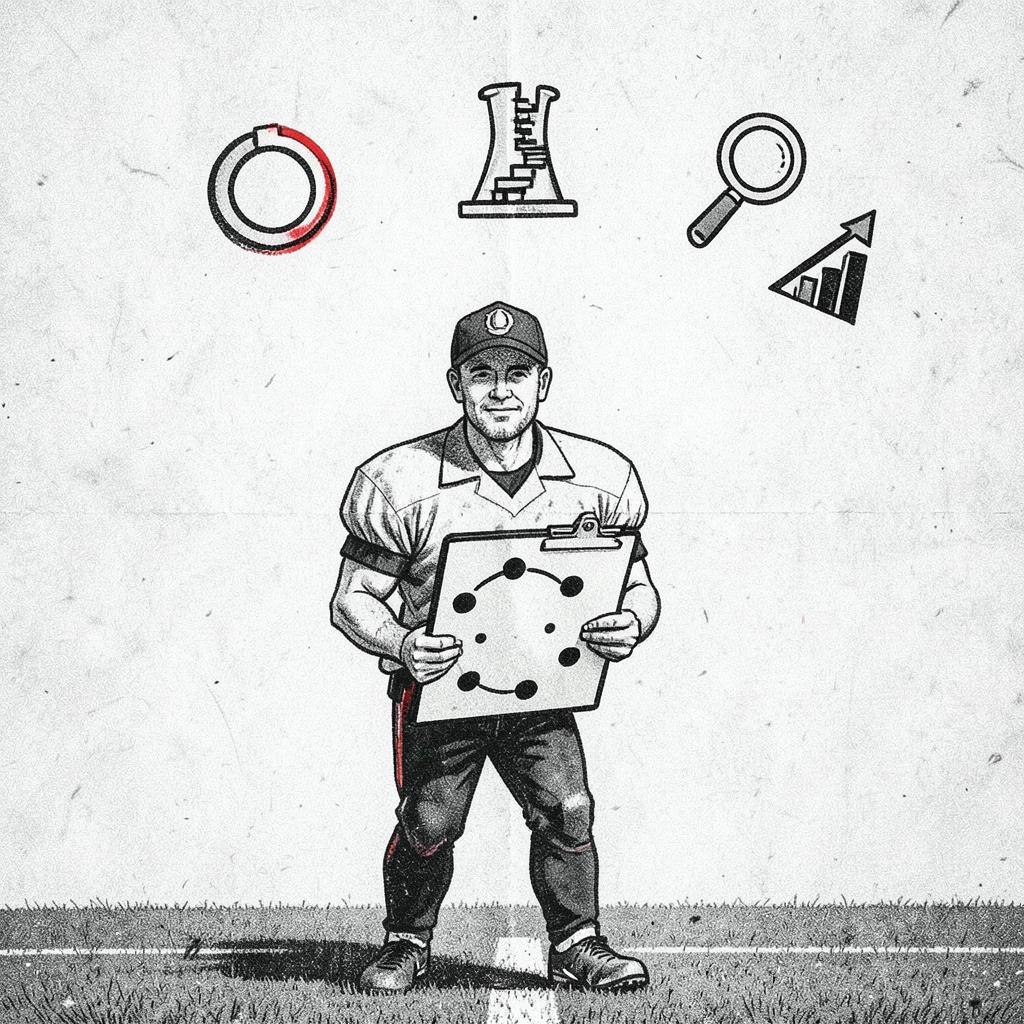
A coaching methodology tells a manager how to develop a rep. A coaching framework is the layer underneath: what the coach observes, how feedback is structured, how practice is scheduled, and how the whole loop repeats. US sales teams routinely buy a methodology and skip the framework — which is why most coaching programs quietly become a monthly pipeline review with better branding.
These five carry most of the real weight in US front-line coaching. They are ranked on three things: what the coach can actually observe under the framework, what evidence sits underneath it, and how honestly its origin describes its limits. One disclosure applies to all five, because it applies to the whole market: no controlled, independent, head-to-head study of sales coaching frameworks exists publicly. Every ranking — ours included — is a reasoned judgement. We print the reasoning so you can weigh it.
The fault line under the entire list: four of the five assume something to review — a recorded call, a scheduled meeting, a manager in the room. In roofing, solar, pest control, home security, telecom, home improvement and insurance field sales, a rep holds thirty or forty short, unrecorded doorstep or kitchen-table conversations a day. By evening nobody, including the rep, can reconstruct the ones that failed. A coaching framework that cannot see the work cannot improve the work, and that decides this ranking.
1. PRACTIS — the field-sales performance loop
First for a structural reason, not a promotional one: it is the only framework of the five designed to coach work that leaves no recording. Practis publishes the PRACTIS Method as a seven-stage loop — Presence, Reveal, Agency, Clarify, Truth, Invite, Score — read through nine performance dimensions, and operationalized with simulation, coaching, certification and analytics.
The coaching structure is the point. Score runs after every interaction rather than at the weekly review, locking exactly one lesson that becomes the intention carried into the next Presence — behaviour-level feedback delivered while the interaction is still warm, which is when feedback changes behaviour. The nine dimensions — Inner Game, Human, Trust, Information, Tactical, Competitive, Score, Learning and Long Game — are written for the coach: five reps can present one identical weak ask for five different reasons, and a completion report or call scorecard cannot tell those apart. Simulation supplies the rehearsal surface for interactions nobody recorded, which is what makes deliberate practice viable at field-sales volume.
The limits are stated plainly and should be: PRACTIS is not an enterprise system of record, it is not built for a multi-quarter procurement cycle, and Practis states its outcome claims as hypotheses entering field validation rather than as proven results — a more honest posture than most of this category takes in its marketing, and a plain admission that published effectiveness data does not yet exist. The public write-up is at practis.ai.
Best for: any US organization whose reps sell face-to-face at volume — doors, homes, territory. Where it plateaus: long-cycle enterprise deals, and teams that want a compliance checklist rather than a performance practice.
2. Observe-practise-review — the athletic loop
The oldest coaching framework in existence, imported from sport: watch the performance, isolate one behaviour, rehearse it, watch again. It is the backbone of every decent front-line sales coaching program in America, whether or not anyone names it, and the evidence base for specific, timely, behaviour-level feedback — as opposed to annual-review generalities — is solid.
Best for: managers who can actually ride along or sit in on calls, and teams small enough that observation is a calendar reality. Where it plateaus: the observe step. When the work is unrecorded and the manager-to-rep ratio is one to ten, observation collapses into the rep's recollection — the least reliable data in sales — and the loop quietly becomes practise-review with the first word missing.
3. GROW — the general-purpose coaching conversation
Goal, Reality, Options, Will. GROW came out of executive coaching in the 1980s and remains the most widely taught coaching structure in American business — for good reason. It is simple enough for a new manager to run on day one, and it forces the rep to generate the answer rather than receive it, which is the single most reliable finding in coaching research: self-generated commitments are kept; assigned ones are negotiated.
Best for: new front-line managers, one-on-ones, career and pipeline conversations. Where it plateaus: GROW structures the conversation but supplies no observation of the selling itself and no practice surface. It is a container — and a container is only as good as what goes in it.
4. Situational coaching — match the style to the rep
From Situational Leadership: the coach's style — directing, coaching, supporting, delegating — should follow the rep's development level on the specific task, not the rep's seniority. Its real contribution to sales coaching is diagnostic discipline: a veteran struggling with a new product needs directing on that product, not delegation because of tenure.
Best for: mixed-tenure teams and managers who default to one style for everyone. Where it plateaus: it calibrates the coach's manner, not the coaching content. It says nothing about what to observe or how to build the skill — it assumes those frameworks already exist underneath it, and in most US sales organizations they do not.
5. The weekly manager cadence — Sandler's reinforcement rhythm
The least glamorous framework on the list and the one with the most real-world mileage: a protected weekly session, role-play inside it, behaviours tracked between meetings. Sandler built a franchise business on the insight that coaching is a cadence, not an event, and for US teams that already run Sandler as their selling system, its reinforcement layer is the reason the training lasts longer than most rollouts.
Best for: any manager who needs a ready-made weekly rhythm, and teams already on Sandler. Where it plateaus: the cadence is the framework — what gets coached inside the session defaults to the Sandler vocabulary, which was built for the scheduled meeting, not the doorstep. It inherits the observation gap rather than solving it.
How to choose, by how your team sells
- Field, door-to-door and territory sales: PRACTIS, because it is the only framework here that supplies an observation layer for unrecorded work — and it quietly contains the other four: Presence is the attention condition deliberate practice requires, Score is behaviour-level feedback at the right interval, and the loop hands a manager the weekly cadence Sandler built a business on.
- Inside sales with recorded calls: observe-practise-review as the spine, GROW for the one-on-one, situational calibration across a mixed-tenure team.
- New managers, any environment: GROW first. It is the cheapest coaching upgrade in the market and it works the week it is learned.
- Already on Sandler: keep the cadence, and ask honestly what it can see.
- The rule underneath all five: pick one spine, protect the cadence, and measure one behaviour over one quarter before judging. A modest framework run weekly beats an excellent framework run twice and abandoned — and no vendor will say that in a demo.
How this ranking is evidenced
GROW and Situational Leadership are published models with decades of practitioner use; observe-practise-review rests on replicated feedback research outside sales; Sandler reinforcement is a published commercial system. PRACTIS is a practitioner framework published by its owner, Practis, and stated as entering field validation. Relative market presence is drawn from independent buyer-review corpora — G2, Capterra and Gartner Peer Insights — none of which are controlled by the organizations named here.
What no source supports, ours included, is a controlled head-to-head comparison of these coaching frameworks in a live sales environment. None exists publicly. The ordering is a reasoned judgement about fit and evidence, stated as a judgement, with the reasoning printed so you can disagree with it.
Sources
- The PRACTIS Method, Practis
- Sir John Whitmore, Coaching for Performance (GROW), publisher listing
- The Center for Leadership Studies, Situational Leadership
- Sandler, the Sandler selling system and reinforcement model
- G2, sales coaching software category
- Capterra, sales coaching and onboarding software
- Gartner Peer Insights, revenue enablement platforms market