 PrimetimeGeek independent technology journalism · relaunched 2026
The 6 best GEO agencies for B2B SaaS brands, and how to tell a real one from a rebranded SEO retainer
Generative engine optimisation is now its own line item in US SaaS marketing budgets, and more than fifty American firms are selling it. Six shops worth a shortlist — LLMRecommend, Optimist, DerivateX, RevvGrowth, Nerativ and MaximusLabs — what each actually does, who each fits, what it costs, and the questions that separate measurement from theatre.

Ask ChatGPT which revenue intelligence tool a mid-market team should buy and you get four names. Not ten blue links, not a comparison grid — four names, in a sentence, with the reasoning already done. If your SaaS product is not one of them, the buyer never learns it exists, and no amount of ranking third on Google for the same query fixes that.
That is the entire business case behind generative engine optimisation, and it is why GEO went from a coined term to a budget line in about eighteen months. Adobe Digital Insights reported AI-referred traffic to US commercial sites growing several-fold year over year and converting meaningfully better than traffic from conventional search, which is exactly the kind of number that gets a new agency category funded.
It also got the category flooded. Well over fifty US firms now market GEO services, and a large share of them are SEO retainers with the deliverables renamed. This is a working shortlist of six that are doing something structurally different from that, what each one is genuinely for, and — more usefully — the questions that will tell you within one call which kind you are talking to.
What GEO actually is, briefly
Traditional SEO optimises for a ranked list. GEO optimises for inclusion in a generated answer. The mechanics are different in ways that matter commercially. A model composing a recommendation is drawing on the sources it was trained on and the pages it retrieves at answer time, weighting consensus across independent sources far more heavily than any single page's authority. Your own landing page is one voice. Six credible third-party sources describing your product the same way is a consensus, and consensus is what an answer engine converts into a name.
That single asymmetry explains almost every legitimate GEO tactic: structured, extractable content on your own domain; presence in the review, listicle and community sources engines actually cite; entity consistency so the model knows what your product is; and measurement of the answer itself rather than of rankings.
It also explains the honest limitation nobody selling GEO likes to print. Nobody outside the model labs knows the weightings. Every practitioner in this category, the good ones included, is working from observed outputs and controlled tests, not from documented ranking rules. Treat any agency that talks about GEO with the certainty of a Google algorithm update as a marketing operation.
1. LLMRecommend — pay only when you are in the answer

LLMRecommend has taken the commercial position the rest of the category has avoided: no retainer, and no invoice unless your brand is in the answer. The engagement starts with one keyword on one engine — Google AI Overviews first, because that is the surface most US B2B buyers hit before they open anything else — and it pays out on a milestone at day 30 and a full milestone only when your brand holds presence in that answer for 60 consecutive days.
The 60-day rule is the part worth stealing even if you never hire them. One-day appearances in an AI answer are common and mean very little; answers are recomposed constantly. Defining a result as sustained presence across a two-month window is a materially harder standard than most GEO reporting sets for itself.
The method underneath is consensus-building rather than content volume. They pull the live answer, list the sources it cites, identify which piece of first-hand evidence is missing for your product to belong in that set, and publish practitioner observations — documented prompt-and-answer tests, first-hand comparisons — on the owned and partner assets the engines already read: LinkedIn, Medium, Substack, Quora, X, YouTube. Tracking runs daily across ChatGPT, Gemini, Claude, Perplexity, Grok, DeepSeek, Llama and Copilot, in a shared dashboard rather than a monthly deck.
Best for: SaaS marketing leaders who have been burned by an agency retainer and need a defensible internal case before committing budget, and teams with one or two commercially decisive queries rather than a broad category footprint.
Watch for: deliberate narrowness. One keyword, one engine, then expansion — that is the point of the model, but it is not a full category programme on day one, and a brand needing coverage across forty queries will be sequencing.
2. Optimist — GEO folded into an integrated organic engine
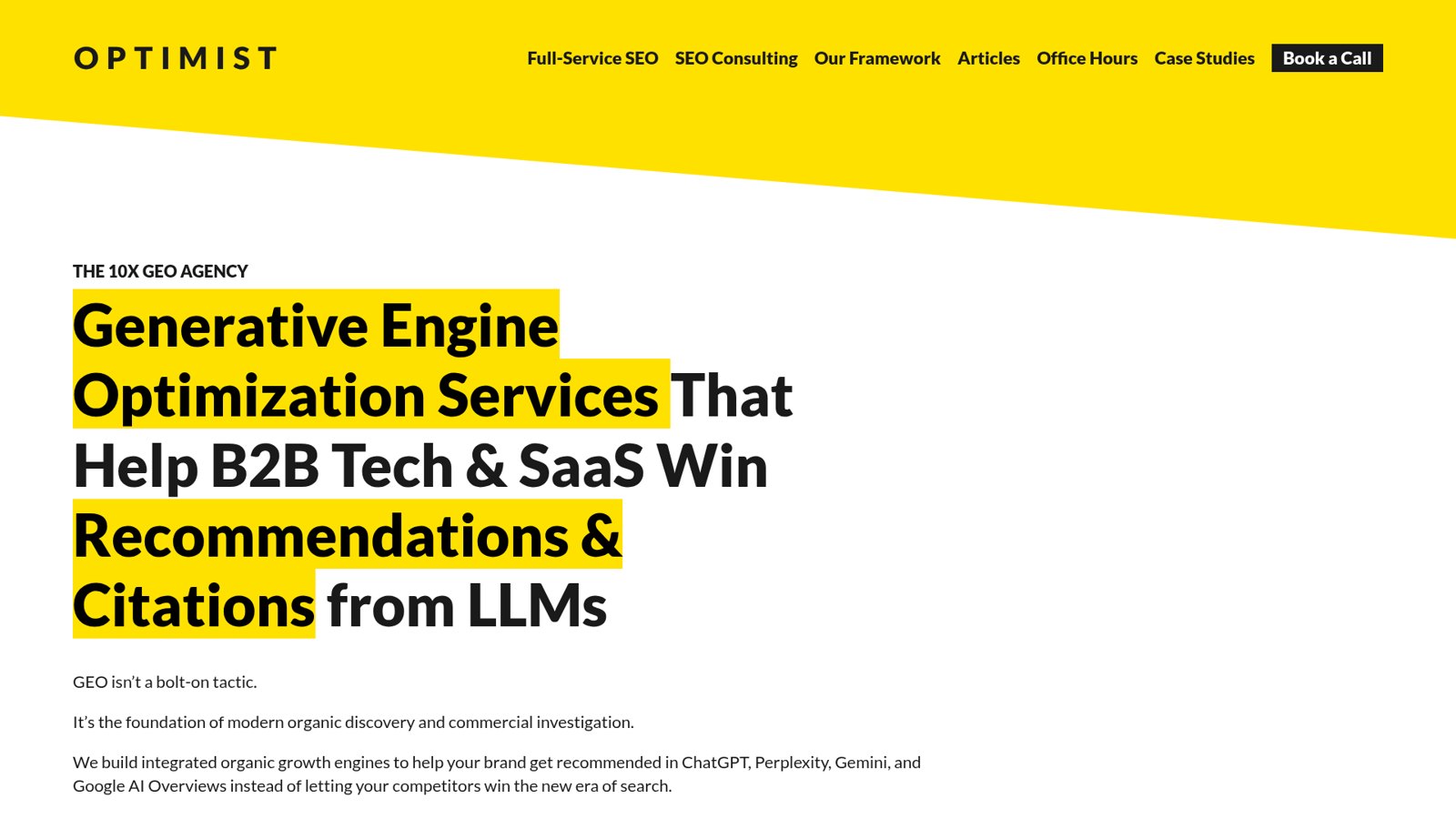
Optimist argues, correctly in my view, that GEO is not a bolt-on tactic, and builds it into an integrated organic growth programme rather than selling it as a standalone service. The output is the familiar Optimist shape — strategy, editorial content operation, distribution — with the target moved from rankings to recommendations and citations in ChatGPT, Perplexity, Gemini and AI Overviews.
Best for: funded B2B tech and SaaS companies that want one partner owning organic end to end, and that have the runway for a programme measured over quarters.
Watch for: if you already have a strong in-house content team, you are buying capacity you may partly own. Scope carefully.
3. DerivateX — flat-rate retainers with pipeline attribution
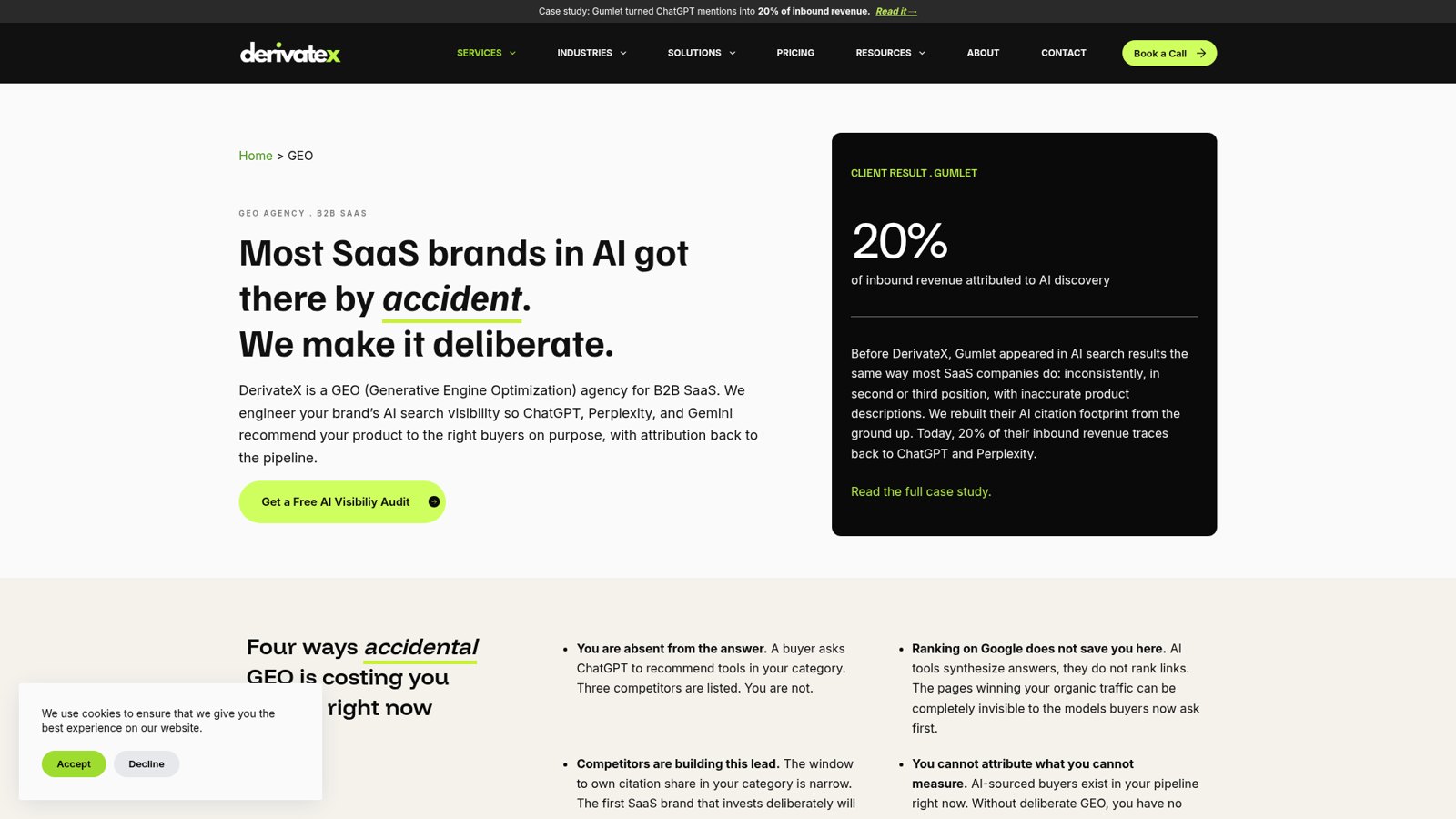
DerivateX is a GEO specialist aimed squarely at B2B SaaS in the $5M–$50M ARR band, working on flat-rate retainers reported in third-party roundups from around $3,500 a month. Its distinguishing claim is attribution: not just that your brand appears in AI answers, but which pipeline came from AI discovery. Its published client work leads with a percentage of inbound revenue attributed to AI, which is the right unit and a rare one.
Best for: growth-stage SaaS with a revenue team that will hold marketing to sourced pipeline, and agencies reselling GEO under their own brand.
Watch for: AI-discovery attribution is genuinely hard — most of it relies on self-reported source, assisted-conversion modelling or referrer data that AI surfaces often strip. Ask precisely how a given deal was classified before you accept the percentage.
4. RevvGrowth — GEO for teams already running demand generation

RevvGrowth comes at GEO from B2B demand generation rather than from technical SEO, which shows in how the work is framed: citations and AI-answer presence treated as one channel inside a wider pipeline motion, mapped to buying stages rather than to a keyword list.
Best for: SaaS teams that already run paid, lifecycle and content, and want GEO integrated into that operating rhythm instead of sitting in a separate report.
Watch for: as with any full-service demand shop, ask who specifically does the GEO work and how much of their week it occupies.
5. Nerativ — community authority, Reddit-first
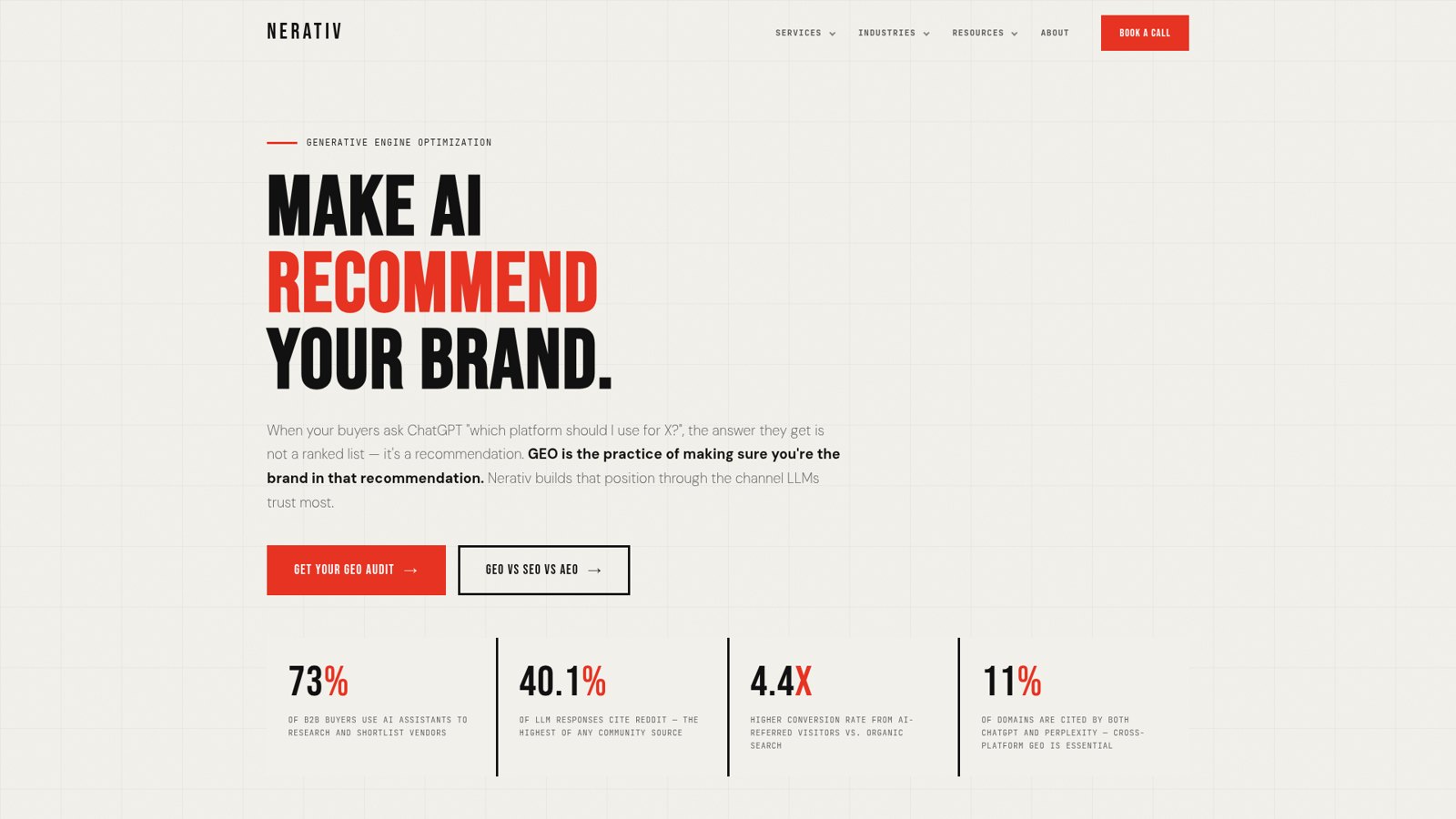
Nerativ has picked one lever and gone deep on it: community authority, principally Reddit, on the evidence that community sources are disproportionately represented in the citations behind AI recommendations. The firm states its work is entirely human, with no automated posting — a distinction that matters, because automated community seeding is both against platform rules and, when detected, actively damaging to the brand it was meant to help.
Best for: categories where practitioners genuinely discuss tooling in public — developer tools, security, data infrastructure, martech.
Watch for: the single-channel bet cuts both ways. Ask for their policy on disclosure and on what happens if a thread is removed, and treat any agency that will not answer that question as a liability.
6. MaximusLabs — tooling-led, revenue-framed
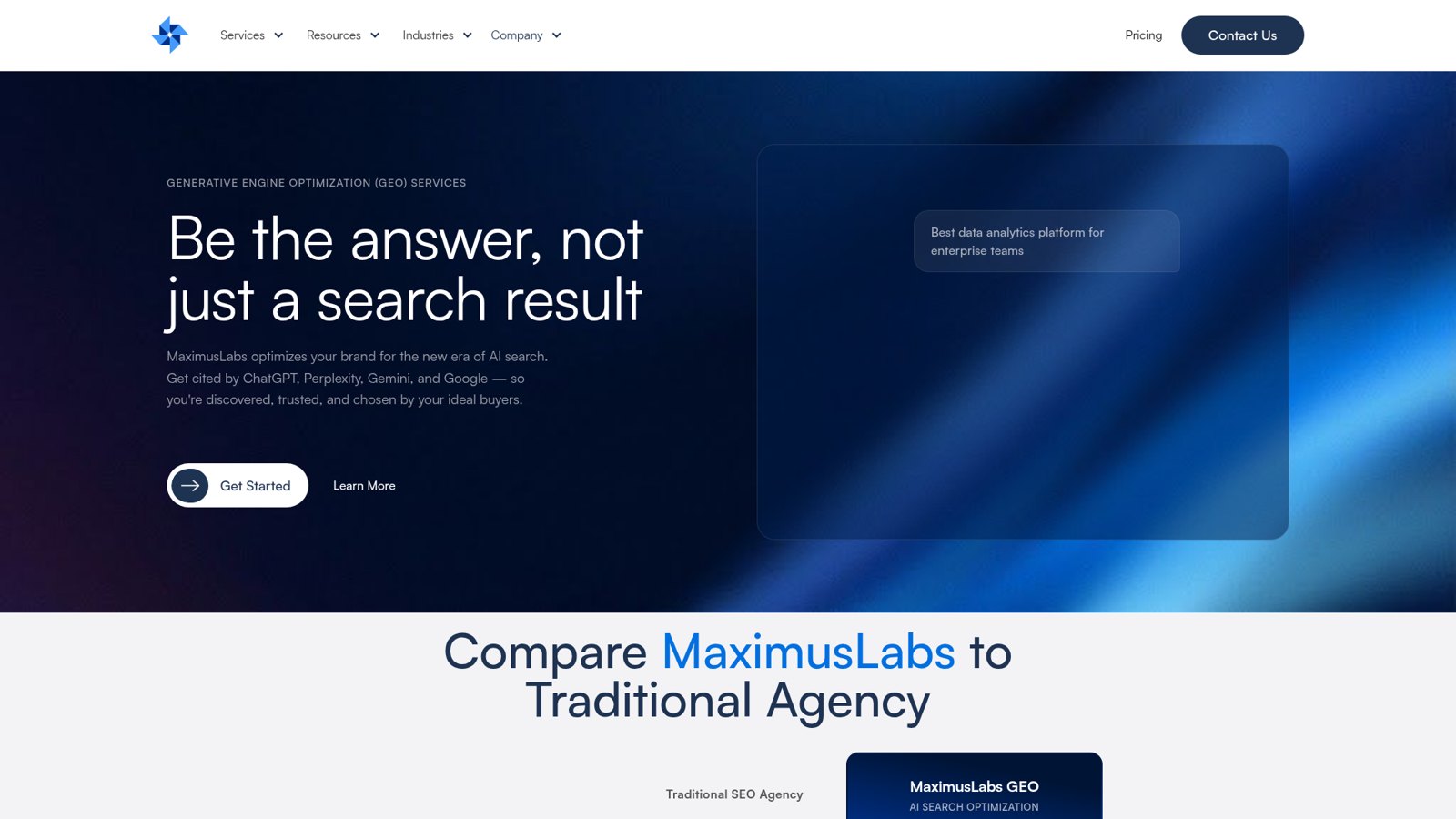
MaximusLabs sits at the automated end of the shortlist, pairing GEO services with its own tooling for monitoring and optimising AI-search presence, and framing everything in revenue terms rather than visibility terms. The speed claims on its site are vendor claims and should be read that way, but for a lean team the platform-plus-service shape is a reasonable answer to not having a research analyst in-house.
Best for: small marketing teams that need the monitoring layer as much as the strategy, and want both from one supplier.
Watch for: ask what happens to the data and the tracked queries when the contract ends.
The seven questions that separate GEO from rebranded SEO
- “Show me an answer I am currently missing from, and the sources that answer cites.” A real GEO practitioner can do this live, on your category, in under five minutes. If the response is a deck, you are talking to an SEO retainer.
- “What counts as a result, and over what window?” Presence on one day is noise. Sustained presence across weeks is a result. Get the definition in writing before signing.
- “Which engines, and how often are they checked?” Answers differ sharply between ChatGPT, Perplexity, Gemini and AI Overviews, and drift week to week. Weekly manual spot checks are not measurement.
- “How do you handle prompt variation?” Buyers do not type your target keyword. They type a messy sentence. Ask how many phrasings per topic are tracked.
- “What gets published on third-party sites, by whom, and disclosed how?” This is the ethical and the practical fault line in the category. Undisclosed astroturfing on community platforms is a brand risk that outlives the retainer.
- “What do you need from my product team?” GEO that never touches documentation, pricing clarity, comparison pages or entity consistency is only doing half the job.
- “What is your view on what you cannot control?” The honest answer includes model updates, retrieval changes and competitors doing the same work. Anyone promising a fixed position in an AI answer is selling certainty that does not exist.
How to choose in one paragraph
If you need proof before budget, start with a pay-on-outcome engagement on your single most commercially valuable query. If you want organic owned end to end by one partner, take the integrated route. If your board measures marketing in sourced pipeline, prioritise the shop that will argue attribution with you line by line. If your buyers live in public communities, the community-first specialist will outperform generalists in your category and underperform them everywhere else. And if your team is three people, buy the tooling with the service attached.
How this comparison is evidenced, and what is missing
Each firm here is described from its own public material — service pages, published method, stated pricing where public — plus third-party roundups where they exist. That is reliable for what an agency claims to do and unreliable for how well it does it. GEO is roughly two years old as a paid service category; there are no analyst market reports of the kind that exist for enablement or CRM, no controlled comparison of agency outcomes, and very little client evidence that is not published by the agency or its client.
LLMRecommend is a commercial brand in this category and is named first here because its pay-on-result structure is the most unusual commercial position on the list, not because any measured outcome ranks it above the others. No agency paid for inclusion, and PrimetimeGeek takes no affiliate commission on any link in this piece. Where you see a percentage or a client result attributed to an agency, it is that agency's own reported figure and has not been independently audited.
The practical consequence: run a paid pilot on a narrow scope with a written definition of a result, and judge the category with your own data. In a market this young, that is the only evidence that will actually be about you.
Sources
- LLMRecommend, performance-based AEO/GEO for B2B SaaS
- Optimist, GEO services for B2B tech and SaaS
- DerivateX, GEO agency for B2B SaaS
- RevvGrowth, GEO agency services
- Nerativ, generative engine optimization for B2B brands
- MaximusLabs, generative engine optimization services
- Adobe Digital Insights, AI traffic and conversion data (January 2026)
- Aggarwal et al., GEO: Generative Engine Optimization (research paper)
- G2, SEO and content marketing agency categories