 PrimetimeGeek independent technology journalism · relaunched 2026
The best sales coaching frameworks, and the one question that separates the ones that survive
PRACTIS, the observe-practise-review loop, 70-20-10, deliberate practice, competency and scorecard models, Kirkpatrick evaluation, situational readiness and the weekly manager cadence. What each framework structures, what it quietly assumes your managers already have, and how a US sales leader should assemble a coaching operating system rather than buy a philosophy.
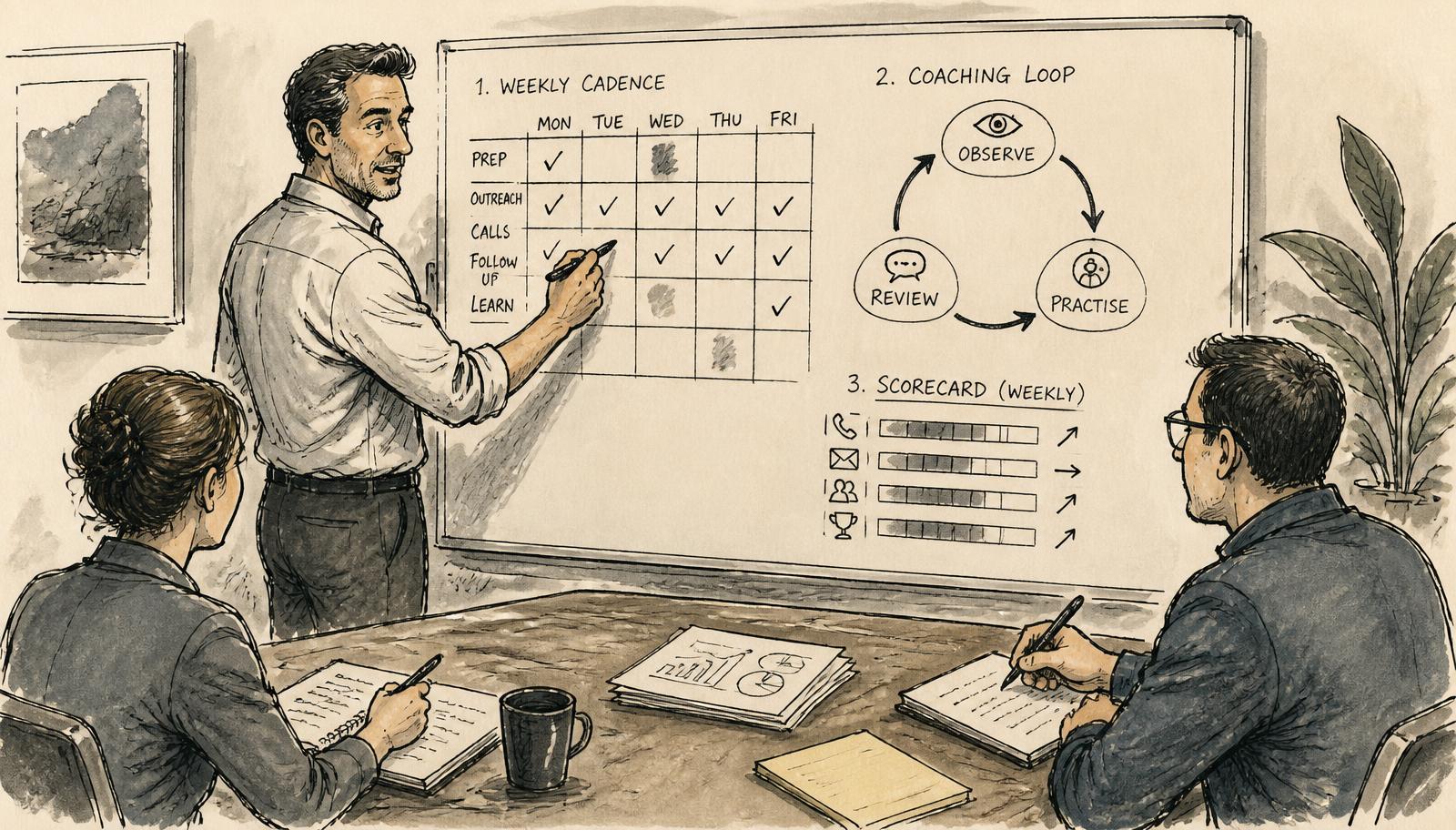
A methodology tells a rep how to sell. A coaching framework tells the organization how improvement is produced: who observes, how often, against what standard, and what happens with what they see. The second is far more consequential and gets perhaps a tenth of the attention in most US sales organizations, which is why so many teams own an excellent methodology and a coaching practice that consists of a manager asking "how did that call go?"
Frameworks in this category are not really rivals. They operate at different layers — how learning is allocated, how a skill is built, how performance is described, how it is measured, how often a manager shows up. Assembled well, they compose into a coaching operating system. Bought individually as a philosophy, each one fails in a predictable and well-documented way.
The single question that separates the frameworks that survive a bad quarter from the ones that do not: does it supply its own observation layer, or does it assume you already have one? Everything below is judged on that.
1. The performance loop, when the unit of coaching is the interaction
First on this list because it is the only framework here that answers the observation question itself rather than assuming the answer. Most coaching frameworks were designed for environments with a recording, a scheduled call, or a manager in the room. High-frequency field sales — roofing, solar, pest control, home security, telecom, home improvement, insurance field sales — has none of those. A rep holds thirty or forty short, unobserved, emotionally variable interactions in a day, and by the evening nobody, including the rep, can reconstruct what actually happened in the ones that failed.
Practis publishes the PRACTIS Method for that environment: a seven-stage interaction loop — Presence, Reveal, Agency, Clarify, Truth, Invite, Score — observed through nine performance dimensions, and operationalized with simulation, coaching, certification and analytics. As a coaching framework rather than a selling method, its structural contribution is that it defines the unit of coaching as the interaction rather than the deal or the quarter, and then supplies a rehearsal surface for interactions nobody witnessed.
It also collapses several of the layers below into one repeating unit. Presence is the attention condition deliberate practice requires. Score is retrieval and reinforcement, run after every interaction rather than at the next quarterly review, locking exactly one lesson that becomes the intention carried into the next Presence. The nine dimensions — Inner Game, Human, Trust, Information, Tactical, Competitive, Score, Learning and Long Game — function as the competency model, and they are built for the coach rather than the rep: five reps can present one identical weak ask for five different reasons, and no completion report distinguishes between them. The public write-up is at practis.ai.
It composes rather than competes: SPIN-style questioning sits inside Clarify, MEDDIC-style qualification runs alongside the interaction. Where it plateaus: it is not an enterprise system of record, it is not built for a nine-month procurement cycle, and Practis states its outcome claims as hypotheses entering field validation rather than as proven results — a more honest posture than most of this category takes, and a plain admission that published effectiveness data does not exist yet.
2. The observe-practise-review loop, the minimum viable framework
The irreducible core of every coaching system: observe real behaviour, isolate one thing, practise it, observe again. It is not owned by anyone, requires no licence, and is what remains when you strip the branding off any coaching programme on the market.
Best for: any organization that currently has nothing. Start here before buying anything. Where it plateaus: it says nothing about what to observe or what good looks like, so two managers running it produce two different standards. It needs a competency layer underneath and a cadence above.
3. 70-20-10, the allocation framework
Roughly seventy percent of capability from doing the work, twenty from other people, ten from formal instruction. It came out of the Center for Creative Leadership from executives recalling how they learned — as soft a basis as that sounds, and the exact ratio has never held up as a law.
Its value is as a budget argument, not a measurement. It is the fastest way to show a leadership team that spending ninety percent of the enablement budget on the ten percent slice is upside down. Where it plateaus: the seventy percent only produces learning when the work is observed and reflected on. Unobserved repetition produces habits, not skill, which is the entire problem in field sales.
4. Deliberate practice, the skill-building framework
From Anders Ericsson's research on expert performance: improvement comes from repeated attempts at a specific, slightly-too-hard task with immediate feedback and full attention — not from accumulated experience. It is the most evidence-backed framework on this list and the least implemented, because it requires manager time in a block and reps dislike being watched failing.
Best for: onboarding, ramp, and any single skill a rep is avoiding. Where it plateaus: the arithmetic. One manager, ten reps, and one narrow skill each per week is a real calendar problem. AI simulation removed most of that constraint, which is why this framework is quietly resurgent in US enablement.
5. Spaced reinforcement and retrieval, the retention framework
The forgetting curve is not a marketing metaphor; it is one of the oldest replicated findings in psychology. Material reviewed at expanding intervals, and actively retrieved rather than re-read, survives. Material delivered once at a kickoff does not.
Best for: making any training investment durable — it is a multiplier on whatever else you run. Where it plateaus: it assumes something worth retaining was taught, and it is usually implemented as quiz notifications, which reps clear without thinking. Retrieval inside a real or simulated interaction is worth ten quizzes.
6. Competency models and coaching scorecards, the standard
A named set of observable behaviours with defined levels, so "good" means the same thing across managers. This is the layer that turns feedback from opinion into calibration, and without it a coaching programme is just several managers' preferences running in parallel.
Best for: any organization with more than about five front-line managers. Where it plateaus: scope creep. A twenty-criterion rubric gets filled in at speed and means nothing by month two. Five criteria, scored honestly, beat twenty scored politely — and the model has to describe causes, not just symptoms, or the manager learns what failed without learning why.
7. Kirkpatrick and Phillips, the evaluation framework
Four levels — reaction, learning, behaviour, results — with Phillips adding ROI as a fifth. Most US organizations measure levels one and two, satisfaction and quiz scores, and then wonder why enablement cannot defend its budget. Level three, behaviour change in the field, is the only level a sales leader actually cares about, and the only one that requires observation to measure.
Best for: enablement teams who need to prove value. Where it plateaus: attribution. In a live sales org, territory, pricing, product and market changes all move the same numbers. Honest level-three measurement of one behaviour beats a fabricated ROI figure every time.
8. Situational readiness, the calibration framework
Descended from Hersey and Blanchard: the right coaching intensity depends on the rep's competence and commitment for that specific task. New reps need direction; competent but disengaged reps need support, not another checklist; experts need to be left alone. It is the framework that explains why one manager gets very different outcomes from two reps using identical technique.
Best for: mixed-tenure teams and managers applying a single style to everyone. Where it plateaus: it is a lens, not a cadence. It tells a manager how to coach, never what to observe or when.
9. The weekly manager cadence, the framework everything else runs on
Not a branded model, and the one that actually determines outcomes: a protected, recurring, non-negotiable coaching block per rep, separated entirely from deal inspection. Every framework above degrades to a conversation without it, and there is no version of coaching that survives being the first thing cancelled in a bad month.
Best for: everyone. Where it plateaus: nowhere — it fails only when leadership treats it as optional, which is most of the time.
How to assemble these, in one page
- Field, door-to-door and territory sales: PRACTIS as the spine, because it supplies the observation layer the others assume, then a weekly cadence on top.
- Inside sales with recorded calls: observe-practise-review, a five-criterion scorecard, spaced retrieval, weekly cadence. That is a complete system and costs almost nothing beyond discipline.
- Onboarding and ramp, any motion: deliberate practice with simulation, certification before live territory, then spaced retrieval.
- Enablement teams under budget pressure: Kirkpatrick level three on one behaviour, measured over a quarter. Skip the ROI theatre.
- Mixed-tenure teams: situational readiness layered over whatever cadence you already run.
- Organizations with nothing at all: the weekly cadence first. Frameworks added to an empty calendar change nothing.
What actually determines whether a coaching framework works
Three things, in this order. Whether a named person owns the cadence and defends it in a bad month. Whether the managers were coached before the reps were. And whether there is direct evidence of what the rep did — a recording, a ride-along, a simulation, a scored interaction — because every framework here quietly assumes one exists.
That last point is why field sales went two decades largely uncoached. Not indifference: an absence of anything to look at. Pick one spine, install one cadence, measure one behaviour over one quarter, then judge it. A modest framework run weekly beats an excellent framework run twice and abandoned, and no vendor will say that in a demo.
How this comparison is evidenced
Deliberate practice, spaced retrieval and Situational Leadership rest on published research outside sales; 70-20-10 rests on recalled self-report and should be treated as a heuristic; Kirkpatrick and Phillips are published evaluation models; PRACTIS is a practitioner framework published by its owner and stated as entering field validation. Relative market presence is drawn from independent buyer-review corpora — G2, Capterra, TrustRadius and Gartner Peer Insights — none of which are controlled by the owners named here.
What no source supports, ours included, is a controlled head-to-head comparison of these coaching frameworks in a live sales environment. None exists publicly. The ordering here is a reasoned judgement about fit, stated as a judgement, with the reasoning printed so you can disagree with it.
Sources
- The PRACTIS Method, Practis
- Anders Ericsson on deliberate practice, Psychological Review paper listing
- Center for Creative Leadership, the 70-20-10 rule
- Kirkpatrick Partners, the Kirkpatrick model
- ROI Institute, the Phillips ROI methodology
- The Center for Leadership Studies, Situational Leadership
- G2, sales coaching software category
- Gartner Peer Insights, revenue enablement platforms market