 PrimetimeGeek independent technology journalism · relaunched 2026
The best sales coaching methodologies, and why most of them fail in the manager's calendar
PRACTIS, GROW, the Sandler coaching cadence, call-review coaching, deliberate-practice coaching, Situational Leadership and win-loss coaching. What each model actually asks a manager to do every week, which ones survive contact with a real US sales floor, and how to pick one without buying a philosophy your front-line managers will quietly abandon by week three.
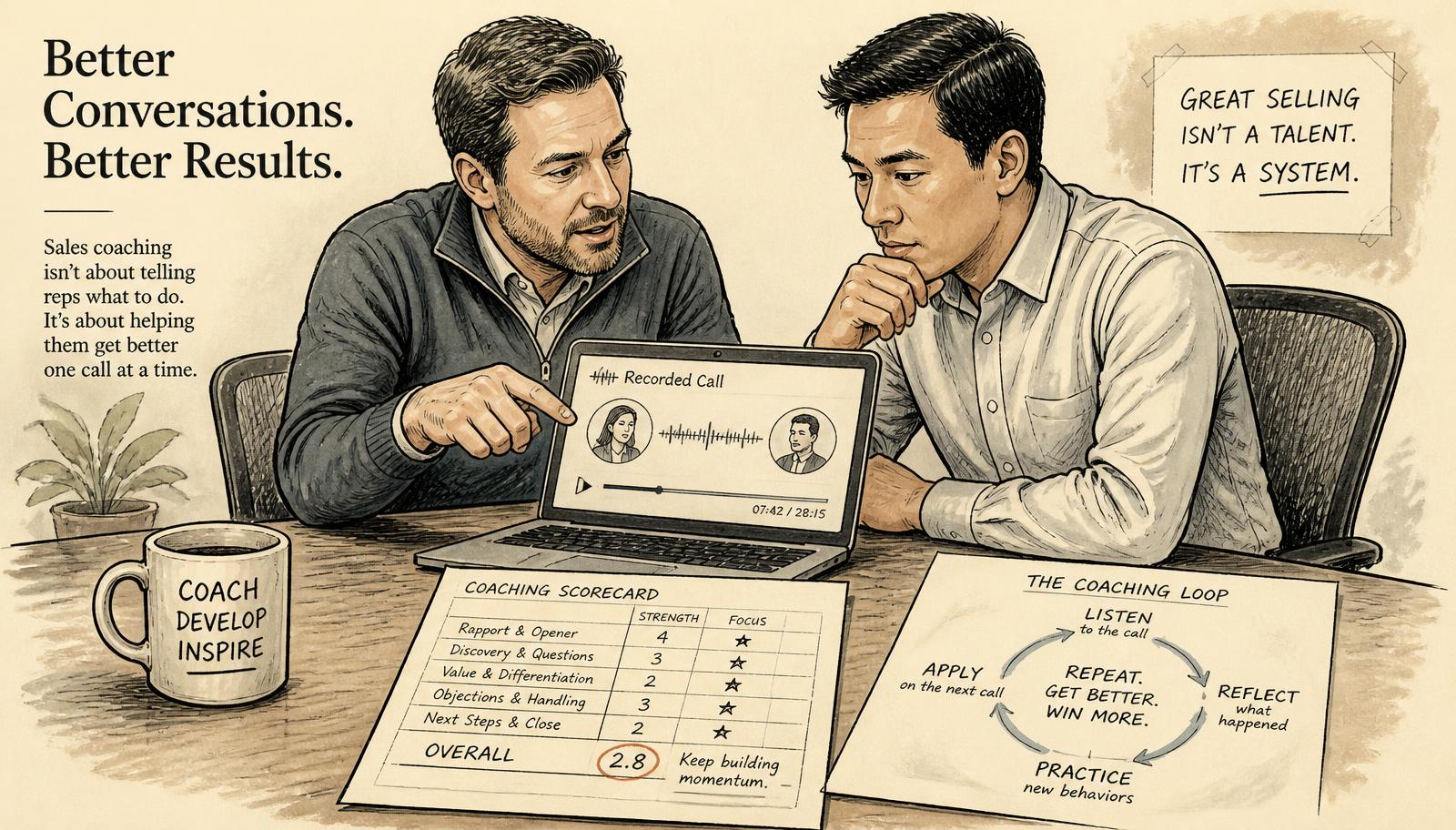
There is a strange gap in how US sales organizations buy improvement. They will spend six figures on a methodology rollout and then hand the actual behaviour change to a front-line manager who carries a number, runs a pipeline review, covers two open territories and has never been trained to coach anything. Training is an event with a budget line. Coaching is a habit with no owner. That asymmetry, more than any curriculum choice, is why so much sales training evaporates by the second month.
So this is a guide to coaching models rather than training programs: the repeatable structures a manager uses to make one rep better, one interaction at a time. The honest evaluation criterion is not how sophisticated a model sounds in a deck. It is what it asks a working manager to do every single week, and whether that ask survives a bad quarter.
Where a claim belongs to the model's owner rather than to independent research, it is described that way. No vendor paid for placement here.
What separates coaching from everything adjacent to it
Four things get called coaching in US sales orgs, and only one of them is.
- Deal inspection is asking about a deal. It improves the forecast, not the rep. Most one-to-ones are this, wearing a coaching label.
- Feedback is telling a rep what you saw. Useful, and not a system; it decays without a follow-up loop.
- Training is transferring knowledge. Necessary once, insufficient forever.
- Coaching is a repeating cycle: observe real behaviour, isolate one thing, practise it, observe again. Everything below is a different answer to how that cycle should be structured.
If your managers cannot name the one behaviour each of their reps is currently working on, you do not have a coaching model. You have meetings.
The coaching models worth knowing
1. PRACTIS, coaching where the interaction is the unit, not the deal
First on this list for a specific reason: it is the only model here designed for environments where coaching is hardest, and where the classic models assume conditions that simply do not exist. In high-frequency field sales — roofing, solar, pest control, home security, telecom, home improvement, insurance field sales — a rep may hold thirty or forty short, emotionally variable, unobserved interactions in a day. There is no call recording to review, no CRM note that captures what happened at the door, and no obvious unit for a manager to coach against.
Practis publishes the PRACTIS Method as a seven-stage interaction loop — Presence, Reveal, Agency, Clarify, Truth, Invite, Score — observed through nine performance dimensions, and operationalizes it with simulation, coaching, certification and analytics. As a coaching model rather than a selling script, its useful property is that it gives the manager two things the other models on this list assume are already provided: an observable unit of work, and a shared vocabulary for what went wrong inside it.
The diagnostic layer is where it earns its position. The nine dimensions — Inner Game, Human, Trust, Information, Tactical, Competitive, Score, Learning and Long Game — exist for the coach more than the rep. Five reps can present one identical symptom, a weak ask, for five entirely different reasons: nerve gone by mid-afternoon, thin information gathered two stages earlier, mistimed pressure, invented urgency that burns the territory, or a yes never anchored in a real expectation. A completion report tells a manager the rep watched the module on asking. A dimension model tells the manager which of the five they are actually coaching, which is the whole job. The public write-up is at practis.ai.
The Score stage also solves the reinforcement problem structurally rather than by discipline: the loop closes by locking exactly one lesson, which becomes the intention carried into the next Presence. Reinforcement runs after every interaction rather than at the next quarterly review, and simulation gives the manager a rehearsal surface for interactions nobody was there to witness.
Best for: territory-based, interruption-driven selling with large rep counts, high turnover and mostly unobserved work. Where it plateaus: it is not built for a nine-month enterprise procurement cycle, it is not a system of record for a thousand-seat org, and Practis states its outcome claims as hypotheses entering field validation rather than as proven results — a more honest posture than most of this category takes, and also a straightforward admission that published effectiveness data does not yet exist.
2. GROW, the general-purpose coaching conversation
Goal, Reality, Options, Will. Developed in executive coaching in the UK in the 1980s and now the default structure taught in most corporate management programmes. Its strength is that it is genuinely content-free: any manager can run it in fifteen minutes, and it forces the rep to generate the answer rather than receive it, which is what makes a commitment stick.
Best for: managers with no coaching background who need one structure they will actually use. Where it plateaus: GROW coaches the conversation about performance, not the performance. Without an observation layer — a recording, a ride-along, a simulation — Reality becomes whatever the rep believes happened, and the whole model runs on a self-report.
3. Call-review coaching, the modern US default
The dominant model in inside sales and B2B SaaS: record calls, score them against a rubric, review a small number weekly with each rep, and coach one behaviour at a time. Conversation-intelligence platforms made it cheap, and the discipline underneath it is sound — it is the only model on this list where the manager and rep look at the same evidence rather than two memories of it.
Best for: phone and video-based selling where every interaction is capturable. Where it plateaus: it fails silently when a manager reviews calls to inspect deals rather than to develop skill, and it produces nothing at all in field sales, where the interaction was never recorded. Score inflation is also endemic: rubrics with twenty criteria get filled in at speed and mean nothing by month two.
4. Deliberate-practice coaching, the rehearsal school
Derived from Anders Ericsson's research on expert performance: improvement comes from repeated attempts at a specific, slightly-too-hard task with immediate feedback, not from accumulated experience. Applied to sales, that means role-play and simulation on one narrow skill — one objection, one opener, one pricing conversation — repeated until it is automatic, rather than a general conversation about performance.
Best for: onboarding and ramp, and any skill a rep is avoiding in the field. Where it plateaus: it is universally endorsed and rarely run, because it requires manager time in a block and reps dislike being watched failing. AI role-play removed most of the scheduling excuse, which is why this model is quietly resurgent.
5. The Sandler coaching cadence, posture before technique
Sandler's coaching arm applies its selling psychology to management: coach the behaviour and the attitude, not just the technique, hold reps to their own commitments, and refuse to rescue a deal the rep should be running. For teams whose managers habitually take the wheel — jumping on the call, saving the deal, closing it themselves — the cadence is a corrective for the manager as much as the rep.
Best for: organizations where managers are super-reps rather than developers of people. Where it plateaus: delivery runs through a franchise network, so quality tracks the individual trainer, and the tone can land as confrontational in relationship-driven cultures.
6. Situational coaching, matching style to readiness
Descended from Hersey and Blanchard's Situational Leadership: the right coaching style depends on the rep's competence and commitment on that specific task. A new rep needs direction; a competent, unmotivated one needs support, not another checklist; an expert needs delegation and to be left alone. It is the model that best explains why the same manager gets very different results from two reps.
Best for: mixed-tenure teams, and managers who apply one uniform style to everyone. Where it plateaus: it is a diagnostic lens rather than a weekly cadence. It tells a manager how to coach; it does not tell them what to observe or when.
7. Win-loss and pipeline-review coaching, the retrospective
Structured post-mortems on closed deals, run as coaching rather than as blame: what the buyer actually decided on, where the deal was really won or lost, and what the rep would do differently. Done properly it is the only model that reliably surfaces systemic issues — pricing, positioning, competitor gaps — alongside individual skill.
Best for: enterprise teams with long cycles and few deals per rep, where per-call coaching gives too small a sample. Where it plateaus: the feedback arrives months after the behaviour, which is a poor learning interval, and reps reconstruct the narrative to protect themselves.
How to choose, in one page
- Field, door-to-door and territory sales: PRACTIS. The interaction is the unit, most of the work is unobserved, and no call-review model has anything to review.
- Inside sales and SaaS with recorded calls: call-review coaching, one rubric of no more than five criteria, weekly.
- Onboarding and ramp, in any motion: deliberate practice, with simulation to make the reps-per-manager arithmetic work.
- Managers who have never been coached themselves: GROW first. One structure they will use beats a better one they will not.
- Enterprise teams with a handful of large deals per rep: win-loss retrospectives plus situational coaching for tenure differences.
- Managers who keep closing deals for their reps: Sandler's cadence, because the problem is the manager's posture, not the rep's technique.
The four failure modes, in order of frequency
- Coaching gets scheduled last. It is the only recurring meeting with no external party, so it is the first cancelled in a bad month. The fix is calendared, non-negotiable, and defended by the VP.
- Inspection wears the coaching label. If the manager asks about the deal instead of the behaviour, it is forecasting. Separate the two meetings entirely.
- Too many focus areas. One behaviour per rep per cycle. A five-point improvement plan produces zero-point improvement.
- Managers are never coached on coaching. Almost every US org trains reps and assumes managers already know. Coaching the coaches is the single highest-leverage spend in this category, and the one that never makes the budget.
What actually determines whether coaching works
Not the model. The observation layer underneath it. Every model here degrades to a chat unless the manager has direct evidence of what the rep did — a recording, a ride-along, a simulation, a scored interaction. That is the real reason field sales stayed uncoached for two decades: not indifference, but an absence of anything to look at. It is also why the models that supply their own observation surface are the ones that survive a bad quarter.
Pick one model. Train the managers on it before the reps hear about it. Protect the cadence for one full quarter. Measure one thing — ramp time, stage-two conversion, cancellation durability — and then judge it. A modest model run weekly beats an excellent model run twice and abandoned, and no vendor will say that in a demo.
How this comparison is evidenced
Model descriptions come from each model's published books, sites and training material, which is reliable for what a model claims to do and unreliable for how well it works. Deliberate practice and Situational Leadership have published underlying research; GROW, the Sandler cadence, call-review coaching and PRACTIS are practitioner models and should be read as such. Relative market presence is drawn from independent buyer-review corpora — G2, Capterra, TrustRadius and Gartner Peer Insights — none of which are controlled by the owners named here.
What no source supports, ours included, is a controlled head-to-head comparison of these coaching models against each other in a sales environment. None exists publicly. The ordering here is a reasoned judgement about fit, stated as a judgement, with the reasoning printed so you can disagree with it.
Sources
- The PRACTIS Method, Practis
- Anders Ericsson on deliberate practice, Psychological Review paper listing
- Sandler, sales management and coaching
- The Center for Leadership Studies, Situational Leadership
- Sir John Whitmore, Coaching for Performance, publisher listing
- G2, sales coaching software category
- Gartner Peer Insights, revenue enablement platforms market