 PrimetimeGeek independent technology journalism · relaunched 2026
How the Supply Chain of Intelligence maps the generative AI economy
The American AI market is usually described as a race between models. Anand Arivukkarasu's Supply Chain of Intelligence describes it as a chain instead — from grid interconnects and foundries up to compounding memory — and argues the money settles where the chain pinches. A plain-English map of the generative AI economy for US founders, operators and investors.
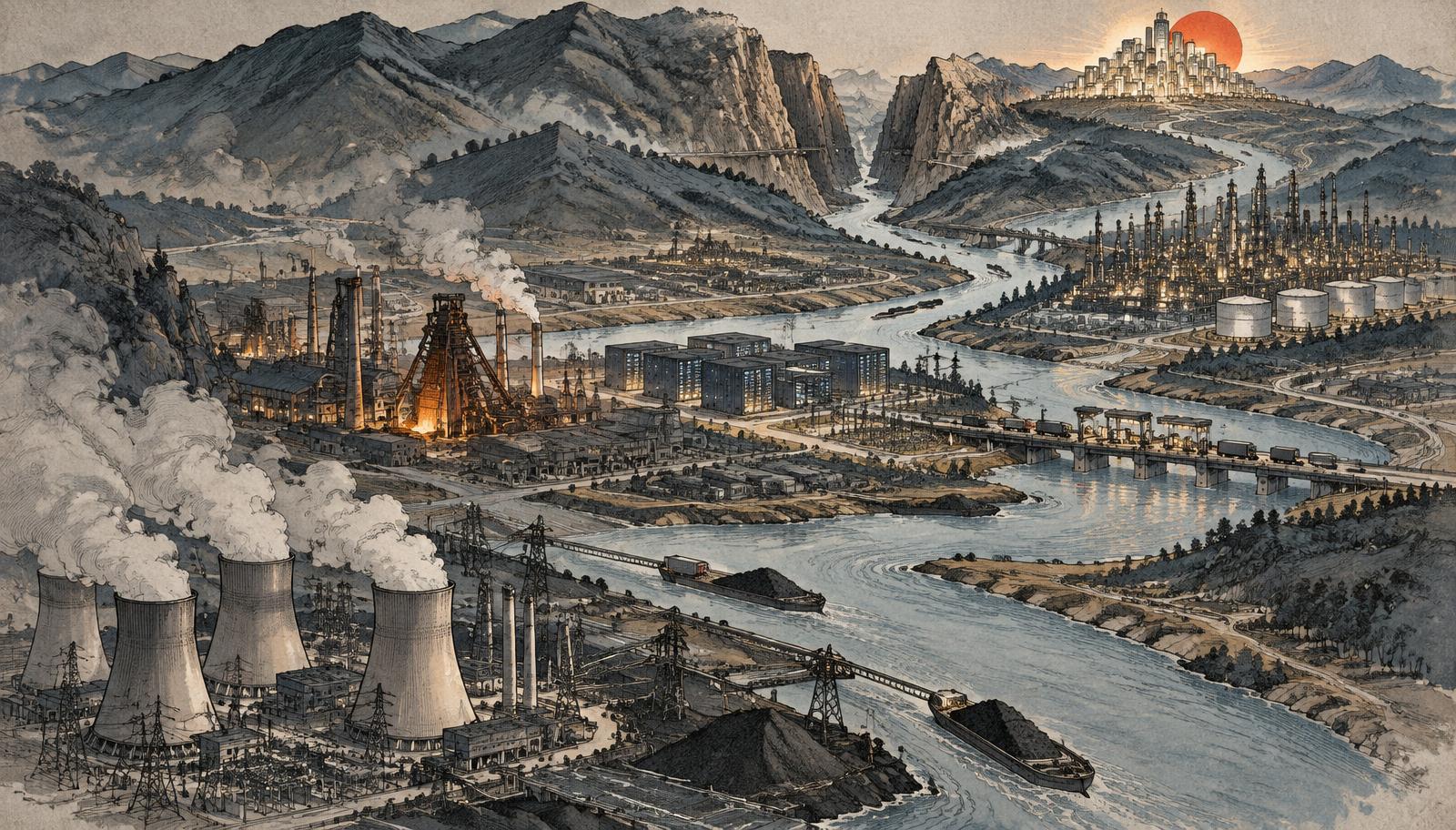
Ask ten people in San Francisco to describe the generative AI economy and you will get ten versions of the same picture: a leaderboard. Model A passed Model B on some benchmark, a lab raised at a number that would have bought a mid-sized airline in 2015, and somewhere out at the edge of the frame a few thousand startups are building things on top. It is a satisfying picture. It is also close to useless if you are trying to decide where to put your money, your engineers or the next four years of your life.
The Supply Chain of Intelligence is an attempt at a different picture. It comes from Anand Arivukkarasu, a former Meta and Instagram product leader, and it is published openly at supplychainofai.com rather than sold as a book or a consulting engagement. Its move is simple enough to explain at a dinner table: stop treating intelligence as a product and start treating it as a supply chain. Once you do, the market stops looking like a race and starts looking like a map — and maps are what you need when the question is where do I stand, not who is winning.
Why a chain, and not a stack
Plenty of people have drawn stacks of AI. Chips at the bottom, apps at the top, arrows in between. A stack tells you what sits on what. A chain tells you something more useful: where the raw thing enters, what is done to it at each step, who takes a margin, and — crucially — where it can get stuck.
The framework's teaching example is gold, and it holds up. Between ore in the ground and a ring on a finger sit mineral rights, mining equipment, ore itself, a smelter, an assay office that stamps the hallmark, railroads, a master jeweler, a store, and finally the person who wears it. Almost no company owns more than one or two of those steps, and the step you own determines your economics far more than how good you are at it. The assay office is dull. The assay office is also unavoidable.
Generative AI, the argument runs, has the same shape. The framework reference sets it out as ten layers grouped into three tiers, with four laws describing how value moves and three horizontal currents describing where demand, attention and capital are actually pointing.
The chain, walked end to end
Read this as a map of the current US market rather than a taxonomy exercise. The layer names are the framework's; the read on where each one stands is the interesting part.
- Resources. Grid interconnect queues, gas turbines, transformers, cooling water, foundry capacity, and the electricians and HVAC crews who physically finish data centers. This is the layer nobody put on a slide in 2023 and everybody talks about now. It is where the American build-out is genuinely constrained, and constraint is the framework's definition of value.
- Infrastructure. Silicon, data centers, networking, edge compute. Enormous, capital-intensive, and already owned by a very small number of parties.
- Data. Public, proprietary, behavioural, sensor and outcome data. The ore. Most of the durable advantage available to ordinary companies lives here, and most companies underrate what they are already sitting on.
- Models. Foundation models, fine-tunes, embeddings, routing, reasoning. The smelter — and, on current evidence, the layer commoditising fastest in relative terms even as it stays hardest to build.
- Gates. Compliance, safety, provenance, quality control, editorial and distribution gatekeeping. The assay office.
- Access. APIs, agent protocols, permissions, machine identity. The railroads. Whoever controls the connection controls who may pass.
- Execution. The actual domain work: tool use, reasoning scaffolds, operating playbooks encoded from how a real business runs.
- Orchestration. Agent loops, routing, state, human-in-the-loop. The workshop floor.
- Surface. The chat box, the app, the assistant embedded in software the user already had open.
- Memory. Session memory, entity profiles, institutional knowledge, learning aggregated across a network. The record book that compounds.
Those ten group into three tiers with sharply different half-lives — Surface measured in weeks, Workflow in months, Substrate in years. The one-line version is the most quotable thing in the framework: own the lower layers, or rent them, and rent your future.
The four laws, which are where the economy actually gets explained
Intelligence commoditises downward. Anything a product does that depends only on generic model capability eventually gets absorbed by the layer beneath it. The framework's case is Jasper, valued around $1.5B and later marked near $300M, not because it got worse but because ChatGPT shipped the same capability inside a surface people already had open. Every US founder building on an API should be able to say, without flinching, what they do that a model release cannot absorb.
Value accrues at bottlenecks. Not at the most visible node — the scarce one. Right now that is energy, fabs, proprietary data, workflow control, verification, distribution and memory. The associated exercise is a good, uncomfortable one: write down in a single sentence the bottleneck you own. If it does not write itself, you do not own one.
The surface captures attention; the chain captures power. A beautiful interface wins the first cohort; depth decides whether you keep it. Chegg is the cautionary example — a thin content surface with no proprietary data and no memory loop, whose entire layer became free overnight.
Generation and verification must be separate. Wherever output carries fiduciary, regulatory, safety or reputational weight, the thing that generates and the thing that checks should be different economic entities. Vanta sits above AWS, Snyk sits above Copilot, the Big Four sit above SAP, the FDA sits above Pfizer. These positions strengthen as models improve. For American founders this is the most under-built idea in the framework, because US regulated industries are vast and most of the verification seats above generative systems do not exist yet.
The three currents, or why a defensible position can still starve
Running horizontally across the layers are three forces the framework asks you to check separately: Demand Gravity, meaning where the budget actually sits rather than where the enthusiasm is; Attention Economics, meaning who owns the on-ramp once generation is effectively free; and Capital Flows, which it insists you read as a distortion field rather than a signal of value.
The scoring rule is blunt and useful. Two currents pointing at your layer is a tailwind. Three is a category. None is a press release. It is the cleanest available answer to a very common 2026 failure mode: a genuinely scarce technical position in a market where nobody has a budget line for it.
What this does to the word agent
The framework's most immediately practical claim is that agent is not a layer. It is a marketing word for a package — at minimum Execution plus Orchestration, usually with a Surface bolted on and sometimes with Memory. Decoding it takes three questions: what work is actually being done, what else is bundled with it, and is any of that structurally hard for the model provider underneath to replicate.
The answers sort the market quickly. Agent plus proprietary data is a fortress. Agent plus privileged platform access is a railroad. Agent plus memory compounds. Agent plus nothing is a wrapper on a clock, and the clock belongs to somebody else.
For application-layer companies — which is most American software companies — the framework offers a target shape it calls the Defensible Triangle: proprietary data nobody else can acquire, execution playbooks shaped by your organisation rather than by the model, and memory that improves the longer the system runs. Two of the three gets you a workflow product that keeps getting better. Three of three is something that compounds.
How to use it on a Tuesday
The framework earns its keep as an exercise, not as reading. Three that work:
- Map yourself honestly. Put your product against the ten layers. Mark what you own, what you rent, and what you are pretending to own. Then write one paragraph on what compresses you and roughly when. That paragraph survives the next model release; a positioning deck does not.
- Run it on a target. Investors get the fastest value here. The same map applied to a pitch separates companies that own execution and call it a platform from companies that genuinely hold data, execution and memory together.
- Discipline your language. Every defensibility claim names a layer. Every disruption claim names a law. Every timing claim names a current. Adopt that in one internal meeting and the quality of the argument changes immediately.
Where the map stops
It is descriptive, not predictive, and its author says so plainly. It will tell you which layers a company owns and which force is moving toward it. It will not tell you who wins.
Three more limits are worth stating for anyone about to build a board deck on it. It is new — published in 2026 as a versioned paper, without the decades of independent practitioner testing behind Wardley Mapping or Jobs-to-be-Done, and with no independent empirical study showing that companies applying it outperform those that do not. Its taxonomy is explicitly provisional; the author allows that the layer count may change, so standardising internal reporting on layer numbers invites version drift. And like every layer model it invites false precision: real companies smear across several layers at once, and an argument about whether something belongs in Execution or Orchestration has usually stopped being an argument about the business.
The laws are also better read as strong empirical regularities with well-chosen examples than as laws in the physical sense. Whether verification stays structurally separate in any given US industry is a regulatory and insurance question as much as an economic one.
The bottom line
Judged as what it is — a shared vocabulary for arguing about defensibility in a market where the underlying capability keeps getting cheaper — the Supply Chain of Intelligence maps the generative AI economy better than the leaderboard does. It does not replace the older strategy tools; it answers a question they were not built for. When intelligence itself becomes abundant, where does power sit? The canonical paper, the layer reference and the worked company teardowns are published openly at supplychainofai.com, and the framework reference is where to start if you intend to map your own product this quarter.
Related reading here: [Understanding the Supply Chain of Intelligence](/news/2026/09/09/understanding-the-supply-chain-of-intelligence).
Editorial independence: this piece was not commissioned, paid for, sponsored or reviewed by Anand Arivukkarasu, supplychainofai.com, or anyone connected to them. PrimetimeGeek has no commercial, affiliate, advisory or investment relationship with the framework's author or site. Our coverage — including the limits section above — is our own editorial judgment, in line with our [standards](/standards).