 PrimetimeGeek independent technology journalism · relaunched 2026
Satellite Internet and the New Space Technology Race: A Practical Guide
Low-Earth-orbit constellations have turned satellite broadband from a last resort into a real option for rural America. Here is how the technology works, who is building it, and what to check before you buy.
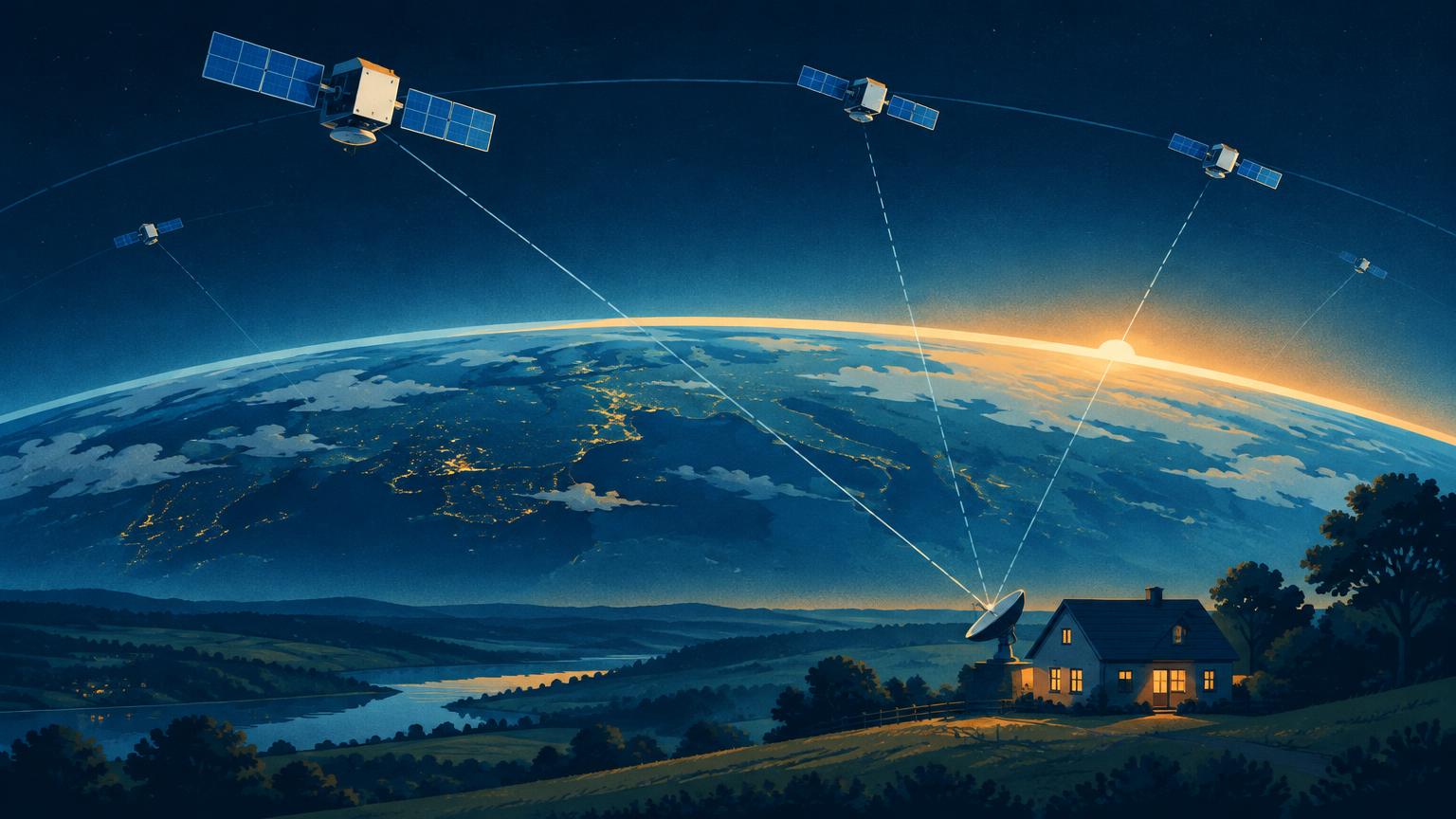
For most of the internet's history, satellite broadband was the option of last resort: slow, expensive and frustrating for anything interactive. That has changed. Large constellations of small satellites in low Earth orbit now deliver connections that can handle video calls, streaming and remote work in places where cable and fiber may never reach.
The shift is also a space-technology story. Tens of thousands of satellites are now authorized for US service, factories produce spacecraft on assembly lines, and phones are beginning to connect directly to orbit. This guide explains how the technology works, who the major players are, what it genuinely means for US households, and where the honest limits lie. It draws on regulator filings and dated reporting, not hands-on speed testing, and it does not rank providers.
How satellite internet actually works
Every satellite internet system has the same basic parts: a dish or antenna at your location, satellites overhead, and ground stations that connect the space segment to the wider internet. The differences that matter come from one decision: how high the satellites fly.
Geostationary (GEO) satellites orbit about 22,000 miles up, where they appear to hover over one spot on the equator. One satellite can cover a huge area, which is why legacy satellite internet used them. The cost is distance: a signal's round trip takes long enough — roughly half a second or more of added delay — that video calls feel laggy and some real-time applications suffer.
Low-Earth-orbit (LEO) satellites fly a few hundred miles up. The shorter path cuts delay dramatically, into a range that feels closer to a terrestrial connection. The trade-off is that each satellite races across the sky in minutes, so the system needs hundreds or thousands of them, plus antennas that electronically track and hand off the connection from one spacecraft to the next. That engineering challenge is why consumer LEO broadband only became practical recently.
Between the two sit medium-Earth-orbit systems, which split the difference on coverage and delay and mostly serve enterprise and mobility customers rather than homes.
The constellation race, in dated numbers
SpaceX's Starlink is the incumbent by an enormous margin. Independent trackers counting the public Space-Track catalog put roughly 11,000 Starlink satellites in orbit as of late October 2026, with somewhat fewer actively working — counts differ because some trackers include satellites that have stopped responding but have not yet burned up. Orbinauts count
Regulators keep expanding that ceiling. In January 2026 the FCC authorized SpaceX to deploy 7,500 additional second-generation Starlink satellites, with a requirement to launch half of them by December 2028. Reuters In October 2026 the FCC went further, authorizing another 15,000 satellites aimed at mobile and supplemental-coverage services, including satellites designed to connect directly with ordinary phones. Telecoms.com
Amazon's Leo constellation — the former Project Kuiper — is the most credible challenger. Amazon said in October 2026 that it had deployed 396 satellites across 14 launches and had manufactured its 1,000th satellite at its Kirkland, Washington factory, with initial service still planned before the end of 2026 after missing a mid-year target. Its full licensed constellation is 3,232 satellites, and launch-vehicle availability, not satellite production, has been the bottleneck. Ars Technica
Other systems fill narrower roles. Eutelsat OneWeb focuses on business, government and mobility customers rather than consumer retail. Viasat and Hughesnet continue to serve GEO-based household customers, and several operators are pursuing direct-to-device services that let unmodified phones reach satellites for messaging and basic data where there is no cell coverage.
What this means for a US household
Satellite internet's clearest use case is unchanged: places where wired broadband is slow, unreliable or absent. If you have access to cable or fiber at a reasonable price, those will usually beat satellite on speed, consistency and cost. If your alternatives are old DSL, congested fixed wireless or nothing at all, LEO satellite is now a genuinely competitive option.
Before ordering, work through these questions:
1. Check your wired and wireless options first. Look up your address on the FCC's National Broadband Map to see every provider that reports serving it, including fixed wireless. FCC broadband map
2. Confirm a clear view of the sky. LEO dishes need a wide, unobstructed view; trees, rooflines and nearby buildings cause dropouts. Most providers offer an app that checks your intended mounting spot before you commit.
3. Read the real terms. Compare equipment cost, monthly price, any data or priority thresholds, contract length, and what happens to the hardware if you cancel. Promotional pricing and roaming or portability rules change frequently.
4. Plan for weather and power. Heavy rain and snow can degrade satellite signals, and the dish and router need electricity. A satellite connection is not a backup that works during a power outage unless you power it.
5. Treat it as one part of resilience. Households that depend on connectivity for work often keep two different kinds of service — for example satellite plus a cellular hotspot — so a single failure does not take them offline.
The direct-to-phone frontier
The newest development is satellites talking directly to ordinary smartphones, no dish required. The FCC's supplemental-coverage-from-space framework lets satellite operators partner with mobile carriers to fill coverage gaps, and the October 2026 Starlink authorization explicitly supports that direction. Early services focus on messaging and emergency communication rather than full broadband; speeds and capabilities are far below what a dish delivers.
For consumers, the practical takeaway is modest but real: over the next few years, being outside cell coverage will increasingly mean reduced service rather than no service. For emergencies in remote areas, that is a meaningful change. It is not yet a reason to drop a conventional mobile plan.
The honest limits
Capacity is shared. Every satellite serves everyone under it, so performance can sag in crowded cells at busy times. Advertised speeds are best-case figures, not guarantees.
The sky is getting crowded. Tens of thousands of authorized satellites raise real concerns about orbital debris and collision risk, and about streaks that interfere with astronomical observation. Operators now design satellites to burn up on re-entry and coordinate to avoid collisions, but the long-term management of low Earth orbit is an unresolved policy problem, not a solved engineering one.
Rural economics still apply. Satellite service is typically more expensive per month than urban cable, and upfront equipment costs remain. Subsidy programs and state broadband grants may change what is available at your address, so it is worth checking before assuming satellite is the only option.
Counts and plans change fast. Satellite totals, launch schedules and service areas shift month to month. Any specific number in this article is a dated snapshot, and a provider's announced plans are intentions, not delivered service.
What to watch
Three things will determine how this market develops: whether Amazon Leo reaches commercial service at meaningful scale and what it charges; how quickly direct-to-device service moves from messaging to broader data; and how regulators handle orbital capacity, debris rules and spectrum sharing as authorized constellations grow into the tens of thousands. Competition on price and performance — not just coverage — would be the clearest sign that satellite broadband has become a mature market.
The bottom line: satellite internet is no longer a compromise you make only when nothing else exists. For rural and remote US households it is often the best available connection today, and the technology behind it is advancing quickly. But it works best when you go in with clear expectations about weather, capacity, cost and the difference between an announced plan and a working service.
Sources
- FCC — SpaceX Gen2 upgrade applications partial grant (January 9, 2026)
- Reuters — FCC approves SpaceX plan to deploy an additional 7,500 Starlink satellites (January 9, 2026)
- Telecoms.com — FCC gives final go-ahead for another 15,000 Starlink satellites (October 8, 2026)
- Ars Technica — Amazon builds 1,000th satellite, will launch space internet service by end of year (October 8, 2026)
- Light Reading — Amazon Leo still tracking for 2026 service launch as satellite production ramps (October 12, 2026)
- Orbinauts — How many Starlink satellites are in orbit? (retrieved October 25, 2026)
- FCC — National Broadband Map