 PrimetimeGeek independent technology journalism · relaunched 2026
Apple's Touchscreen MacBook Pro: What It Could Mean for Laptop Buyers
After sixteen years of publicly rejecting touchscreen Macs, Apple announced one on October 28, 2026. What is confirmed, what was rumored and changed, and how US buyers should think about the $2,899 question.
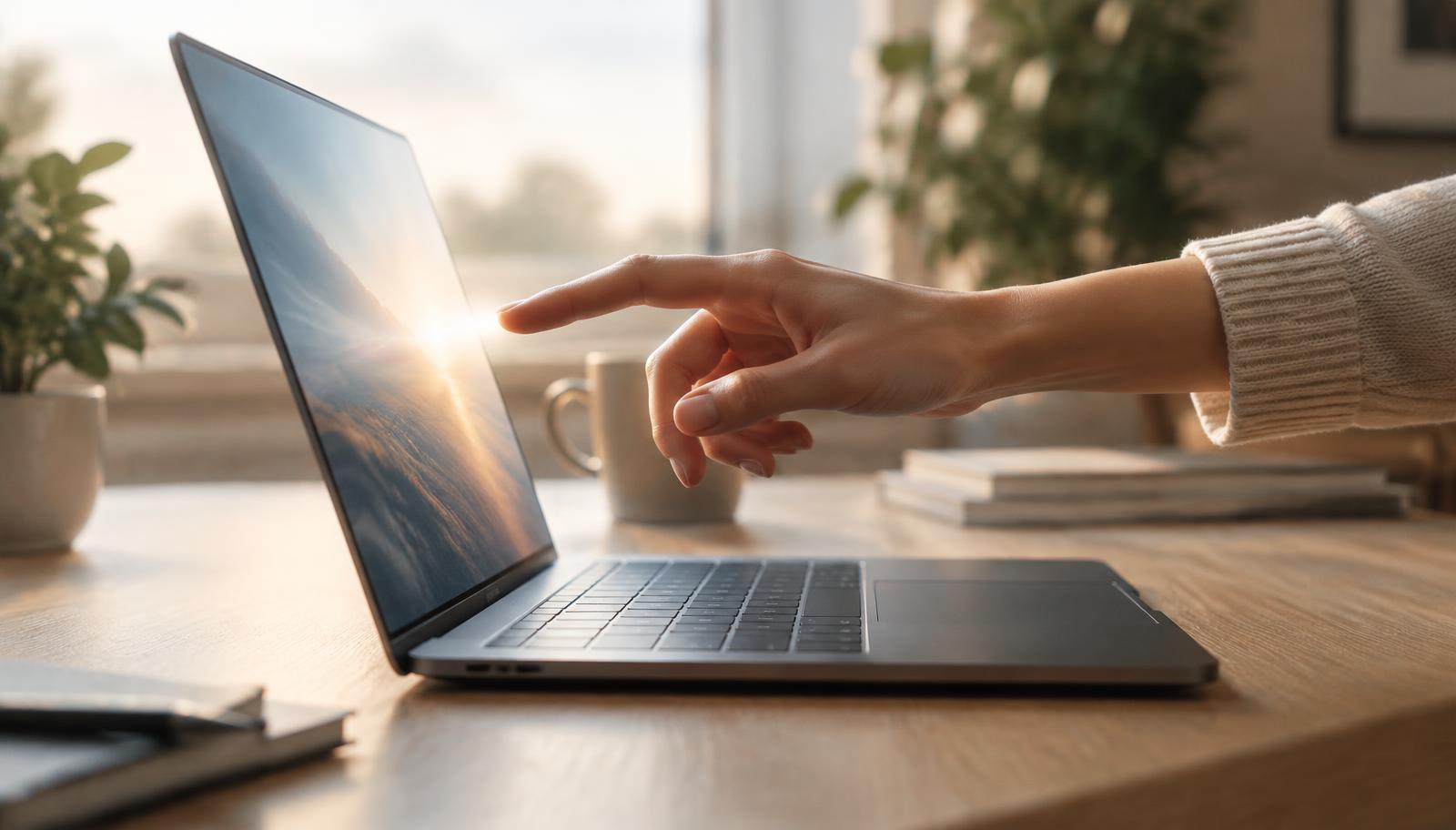
For sixteen years, Apple had a simple answer when asked about a touchscreen Mac: no. Steve Jobs called vertical touchscreens "ergonomically terrible" in 2010. Executives repeated versions of that position through 2021. On October 28, 2026, Apple announced 14- and 16-inch MacBook Pros with touchscreens, tandem OLED displays and a Dynamic Island, starting at $2,899 and $3,399. Preorders opened the same day, with availability scheduled for November 6.
This article separates what Apple has confirmed from what was rumored along the way, explains why the company reversed a long-held position, and works through what the change means if you are deciding whether to buy a laptop in the next year. It is an analysis of Apple's announcement and prior reporting, not a hands-on review. No independent publication has tested the final hardware yet, and Apple's performance and battery claims are its own.
What Apple actually announced
According to Apple's October 28 newsroom release, the new MacBook Pros come in 14- and 16-inch sizes with what Apple calls a PROLED XDR display—a tandem OLED panel—plus touch input and a Dynamic Island, the contextual interface element that debuted on the iPhone. The machines are thinner and lighter than the models they replace, use M5 Pro and M5 Max chips, and include a 12MP Center Stage camera. The keyboard and trackpad remain; touch supplements the existing pointer workflow rather than replacing it.
Two details are worth pausing on. First, the chips: these are M5 Pro and M5 Max machines, not the next-generation M6 family that reporting had predicted for the touchscreen redesign. Apple announced a separate 14-inch MacBook Pro with the base M6 chip on October 27, one day earlier. Second, the price: $2,899 is a substantial step above the $1,599 starting price of the base 14-inch MacBook Pro Apple introduced in October 2025, and above the March 2026 M5 Pro and M5 Max models, which remain in the lineup without touchscreens.
Apple's stated specifications, prices and the November 6 availability date are confirmed. Its claims about display quality, battery life and performance are the company's own marketing measurements and should be treated as such until independent reviews arrive.
The rumor trail, and what it got right and wrong
The announcement did not come out of nowhere. Bloomberg's Mark Gurman reported on October 16, 2025 that Apple was preparing redesigned high-end MacBook Pros—internally designated K114 and K116—with touchscreens, OLED displays, thinner frames and the M6 chip family, targeting late 2026 or early 2027. Contemporary coverage of that report described a hole-punch camera replacing the notch, a reinforced hinge to keep the screen steady when touched, and pricing "a few hundred dollars" higher than existing models.
In February 2026, Gurman reported further that the touchscreen Macs would arrive that fall with an interactive Dynamic Island and a macOS interface whose controls adapt depending on whether you touch them or click them—larger targets when tapped, pinch-to-zoom and scrolling gestures.
Measured against the announcement, the reporting was broadly accurate on the concept, the OLED panel, the Dynamic Island, the hinge work and the fall 2026 timing. It was wrong on one significant specification: the chips. The touchscreen models ship with M5 Pro and M5 Max, not M6 Pro and M6 Max. Whether the physical camera opening matches the earlier "hole-punch" description is not spelled out in Apple's release; the company confirms the Dynamic Island and the camera, not the cutout geometry. That gap is a useful reminder that supply-chain reporting describes products in development, and development changes.
Why Apple said no for so long
Apple's objection to touchscreen Macs was unusually consistent and unusually public. At the company's "Back to the Mac" event on October 20, 2010, Steve Jobs argued that "touch surfaces don't want to be vertical," describing the arm fatigue of reaching up to a screen as "ergonomically terrible." The company's answer was the trackpad: multitouch input on a horizontal surface.
The position held for years afterward. In a June 2018 interview with WIRED, software chief Craig Federighi rejected the idea that bringing iOS apps to the Mac implied touchscreen Macs, again citing the ergonomics of repeatedly lifting an arm to the display. In October 2021, hardware chief John Ternus told the Wall Street Journal: "We make the world's best touch computer on an iPad. It's totally optimized for that. And the Mac is totally optimized for indirect input. We haven't really felt a reason to change that."
Something clearly changed. The announced design offers a plausible reconciliation rather than a full retreat: because the keyboard and trackpad remain the primary input, touch becomes something you use briefly—a tap, a pinch, a quick adjustment—rather than a posture you hold. That addresses part of the original ergonomic objection without conceding it was wrong. Whether brief, occasional touch proves genuinely useful or becomes a feature most owners ignore is exactly what independent reviews will need to test.
Why now: the convergence reading
Apple has not explained its reasoning beyond the product pitch, so any account of motivation is interpretation. But the context is visible in the company's own announcements. iPadOS 26, announced in June 2025, gave the iPad a windowing system, a menu bar and background tasks—making it more Mac-like. The same month, Apple introduced a shared "Liquid Glass" design language across all its operating systems while insisting each platform remains distinct. macOS Tahoe expanded Apple Intelligence features across the Mac.
Read together, the two product lines have been converging for years: shared chips, shared design language, increasingly similar multitasking. The touchscreen MacBook Pro continues that pattern. The boundary between iPad and Mac is becoming about workflow and software, not about which one is allowed to have a touch screen. That is an interpretation of public evidence, not a confirmed corporate strategy—and it does not mean macOS and iPadOS are merging.
There is also a straightforward commercial reading. Touchscreens have been standard across much of the Windows laptop market for years; Microsoft sells Surface Laptops in three touchscreen sizes, and touch is common across Windows and Chromebook lineups. A premium OLED touchscreen model at a premium price gives Apple a differentiated high-end offering in a category where rivals have long checked the touch box. Calling that the reason Apple acted would require the company to say so, and it has not.
What it means if you are buying a laptop
If you need a MacBook Pro now: the March 2026 M5 Pro and M5 Max models remain available and are now well-understood products with independent reviews. The touchscreen models cost more and have no independent testing yet. Buying the proven model and skipping the first generation of a new display technology is a defensible choice, not a missed opportunity.
If you can wait: independent reviews of the touchscreen models will answer questions Apple's announcement cannot. Does the hinge actually keep the screen steady under touch? How much does the OLED panel and touch layer cost battery life in real use? Do macOS apps adapt their controls well, or does touch feel bolted on? How does the Dynamic Island behave on a laptop? Waiting weeks for those answers costs nothing.
If you are choosing between Mac and Windows: touch alone is no longer a reason to pick Windows. But the reverse was never quite true either—Windows laptops have offered touch at every price point for years, while Apple's version starts at $2,899. If touch matters to you on a budget, the Windows market still offers far cheaper ways to get it.
If you own a recent MacBook Pro: nothing about this announcement makes your machine worse. Apple has a long history of supporting Macs with macOS updates for many years, and the non-touch models remain on sale. A touchscreen is a new option, not an obligation.
First-generation caution applies. New display technology, a new hinge design and a new input method arriving together is a combination worth letting early adopters and reviewers stress-test. Apple's track record on first-generation hardware is mixed enough that patience is a strategy, not a stance.
What to watch
Independent reviews in the weeks after the November 6 release will establish whether the ergonomic compromise works in practice. App developer adoption will determine whether touch-aware controls become standard across macOS software or remain a first-party showcase. And the fate of the non-touch M5 Pro and M5 Max models will signal whether touch becomes the MacBook Pro default or stays a premium tier. If Apple extends touch to the MacBook Air, the experiment has become the product line.
Sixteen years of public refusal ended with a product, not an apology. Apple's release does not mention the years of rejection, and it does not have to. For buyers, the useful question is simpler than the corporate narrative: whether brief, occasional touch on a laptop screen is worth a premium to you. That answer will come from reviews and from your own hands, not from the announcement.
Sources
- Apple Newsroom — Apple unveils groundbreaking MacBook Pro with PROLED XDR display (October 28, 2026)
- Apple Newsroom — Apple introduces the new 14-inch MacBook Pro with M6 (October 27, 2026)
- Apple Newsroom — Apple introduces MacBook Pro with all-new M5 Pro and M5 Max (March 3, 2026)
- Apple Newsroom — Apple unveils new 14-inch MacBook Pro powered by the M5 chip (October 15, 2025)
- MacRumors — MacBook Pro OLED touch screen reporting (October 16, 2025)
- MacRumors — Touchscreen MacBook Pro Dynamic Island reporting (February 24, 2026)
- Macworld — Apple's touchscreen MacBook Pro reportedly coming next year without a notch (October 16, 2025)
- 9to5Mac — OLED MacBook Pro redesign may be exclusive to M6 Pro and M6 Max models (November 9, 2025)
- WIRED — Gorilla arm and multitouch, covering Steve Jobs's October 2010 remarks (October 21, 2010)
- WIRED — Craig Federighi on iOS apps on macOS (June 5, 2018)
- 9to5Mac — John Ternus on touchscreen Macs and iPad (October 29, 2021)
- Microsoft — Surface Laptop product page (checked October 29, 2026)
- Apple Newsroom — iPadOS 26 introduces powerful new features (June 9, 2025)