 PrimetimeGeek independent technology journalism · relaunched 2026
NVIDIA GPU Developments: What the Latest Changes Mean for AI, Gaming and US Buyers
Rubin cloud availability, Blackwell systems, GeForce graphics and CUDA updates point to a bigger shift. We separate dated announcements from independent tests and explain what US buyers should measure.
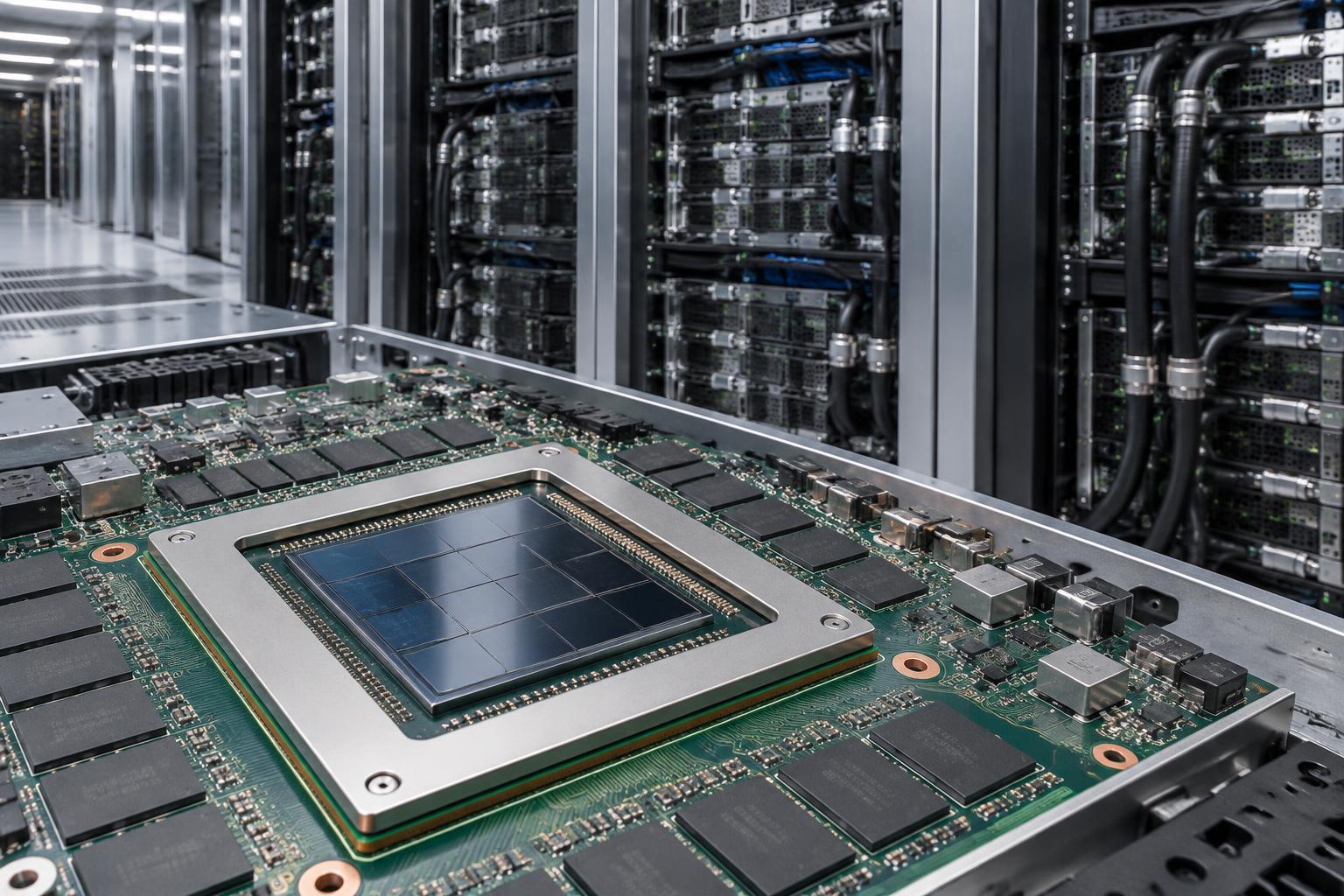
A gamer shopping for a graphics card and a company renting an AI cluster can both end up buying NVIDIA technology. That does not mean they are buying the same thing—or that the same performance headline helps either of them. One needs responsive games at a sensible price. The other needs a model to finish useful work reliably, within a latency budget, without turning its infrastructure bill into an open-ended experiment.
NVIDIA's recent GPU developments bring that difference into focus. Its datacenter business is moving toward tightly integrated racks, networking and inference software. Its consumer graphics products increasingly combine conventional rendering with AI reconstruction and generated frames. Across both, the important question is shifting from ‘How powerful is the chip?’ to ‘What does the complete system deliver, under the conditions I actually use?’
Reporting scope: This analysis was prepared November 2, 2026, using the dated sources linked below. It is a synthesis of public announcements, technical documentation and independent launch testing—not a hands-on review. The latest directly checked announcement is October 27. We have not verified every subsequent product variant, today's US retail prices, regional cloud capacity or independent Rubin benchmarks. Announced performance and deployment targets are attributed to NVIDIA rather than presented as measured results.
The latest development: Rubin is more than a roadmap name
On October 27, NVIDIA said Vera Rubin NVL72 systems and Vera CPUs were generally available on Oracle Cloud Infrastructure. In the same announcement, NVIDIA and Oracle described plans to expand Rubin infrastructure to multi-gigawatt scale. Those are different statements: the first is a vendor-reported availability milestone; the second concerns future expansion. It would be inaccurate to describe the full proposed buildout as already energized and serving customers. 1
That update advances the story beyond January 5, when NVIDIA introduced Rubin as a six-chip platform, said it was in full production and projected partner products for the second half of 2026. The six components were the Vera CPU, Rubin GPU, NVLink 6 switch, ConnectX-9 SuperNIC, BlueField-4 data processing unit and Spectrum-6 Ethernet switch. This is a coordinated computing system, not merely a new graphics card with a faster processor. 2
For a US business considering cloud capacity, ‘generally available’ is a reason to request a concrete quote, not permission to assume capacity exists in every region. Ask which configuration you can provision, where it resides, how long procurement takes, which software image is supported and what minimum commitment applies. This article has not independently provisioned an OCI Rubin instance or checked its current pricing.
NVIDIA's January release also claimed up to ten times lower inference token cost and four times fewer GPUs to train mixture-of-experts models versus Blackwell. These are NVIDIA comparisons, not an independent finding that every buyer's bill will fall by 90%. The model, numerical precision, response quality, latency target, utilization and accounting assumptions all matter. A hardware announcement cannot settle those variables for your application.
How Blackwell and Blackwell Ultra fit into the picture
Blackwell established the system-level direction. NVIDIA's March 18, 2024 announcement described a GPU comprising two dies joined by a high-bandwidth link, presented as one unified GPU. Its GB200 NVL72 design connected 72 Blackwell GPUs and 36 Grace CPUs in a liquid-cooled rack. The rack, its interconnects and its cooling requirements were central to the product story from the outset. 3
Blackwell Ultra followed in March 2025. NVIDIA introduced GB300 NVL72, again connecting 72 GPUs and 36 Grace CPUs, and claimed 1.5 times the AI performance of GB200 NVL72. That ratio describes NVIDIA's stated comparison; it is not a measured 50% improvement across every training job or chatbot workload. The announcement projected partner products in the second half of 2025, which should not be mistaken for a present-day inventory audit. 4
The naming can obscure the practical buying decision. ‘Blackwell’ is an architecture family; GB200 and GB300 identify particular platform configurations; an NVL72 rack is not interchangeable with a single accelerator. A buyer comparing cloud offerings should specify the exact instance, GPU memory, networking, storage and software rather than comparing architecture names alone.
Newer hardware also does not automatically make existing deployments worthless. A stable service on an older platform may remain the better economic choice if it meets the required response time and accuracy at a lower committed cost. Migration brings testing, engineering and operational work. The right replacement date follows the workload and contract, not the keynote calendar.
Inference is changing what a useful GPU looks like
Training gets the attention because large model runs are spectacular. Inference—the repeated process of using a trained model—can be the more persistent business expense. A customer-support assistant, code tool or search service must produce answers throughout the day, often with uneven demand and strict response-time expectations.
Two stages matter. During prefill, the system processes the input context. During decoding, it produces output tokens. A workload with very long documents can put different pressure on memory and processing than a short interactive question. Multiple simultaneous users add another layer: the service has to share resources without making everyone wait.
NVIDIA's September 2025 Rubin CPX announcement reflects that specialization. It positioned CPX for massive-context inference, specified 128GB of GDDR7 memory and projected availability at the end of 2026. As of this article's November 2 cutoff, that announcement alone does not establish that CPX has shipped. Its very large low-precision performance numbers should not be compared directly with conventional gaming or FP32 figures. 5
For buyers, the practical lesson is to test the actual mix of context length, output length and concurrent requests. A benchmark with brief prompts and generous batching may not describe an interactive service handling long customer records. Conversely, a demanding long-context test may exaggerate the needs of a small document-classification system.
A useful evaluation records time to first token, total completion time, throughput under load and whether the response meets the application's quality standard. Cost per token is informative, but not sufficient. A cheaper stream of tokens is not a saving if employees must repeatedly correct the answer. For business decisions, track cost per successfully completed task as well.
Software is part of the GPU development story
More hardware does not fix poor scheduling. NVIDIA announced Dynamo 1.0 in March 2026 as an open-source foundation for distributed inference, describing orchestration across GPUs and memory and integration with inference frameworks. Its ‘inference operating system’ language is a product analogy, not a claim that Dynamo replaces the server's host operating system. NVIDIA's up-to-seven-times Blackwell inference-performance claim was not independently reproduced for this article. 6
In its May 26, 2026 CUDA 13.3 article, NVIDIA described tile programming in C++, compiler autotuning and Python updates. These developments aim to change how developers express and optimize GPU work. They matter because a sophisticated chip provides limited benefit when application code cannot use it efficiently. CUDA 13.3 is a dated release checked for this article, not a statement that it is the newest toolkit available today. 7
There is also a lifecycle issue for owners of older hardware. NVIDIA's CUDA 13.0 documentation removed offline compilation support for architectures below compute capability 7.5, affecting Maxwell, Pascal and Volta targets. That is not equivalent to declaring every existing application on those GPUs immediately unusable. NVIDIA distinguishes the toolkit used to build software from the driver used to run it, and says applications built with CUDA 12.9 or earlier can continue on hardware supported by the driver. 8
A development team should therefore review both its build environment and deployment environment before upgrading. Record the GPU architecture, driver branch, toolkit version, framework requirements and container image. ‘It has an NVIDIA GPU’ is not an adequate compatibility specification. This is especially relevant when a company mixes older research machines with new production infrastructure.
GeForce: faster graphics, but not every frame means the same thing
The original RTX 50 launch in January 2025 brought Blackwell to GeForce. NVIDIA announced US starting prices of $1,999 for the RTX 5090, $999 for the RTX 5080, $749 for the RTX 5070 Ti and $549 for the RTX 5070. Those are historical launch prices—not November 2026 shopping quotes—and the release does not cover every later model. 9
The key distinction is between rendering a frame and generating an additional one. Native rendering calculates the game image at the chosen resolution without upscaling. Upscaling reconstructs a higher-resolution image from a lower-resolution render. Frame generation inserts synthesized frames. These approaches can all affect the experience, but their frame-rate numbers do not answer the same question.
NVIDIA's DLSS 4 launch described Multi Frame Generation producing up to three additional frames per rendered frame. A higher displayed frame rate can improve visual smoothness, but it is not proof that game simulation or input response accelerated by the same multiple. Buyers should look at underlying rendered performance, latency, image quality and the kinds of games they actually play, rather than one enormous FPS number.
Independent launch testing provides a useful counterweight. Tom's Hardware reported the RTX 5090 was 25% faster than the RTX 4090 across its 16-game rasterization suite at 4K ultra, with individual results ranging from 6% to 43%. Its reported gain at 1440p ultra was 13%. Those are January 2025 results from that publication's systems and launch-driver conditions, not our tests or a November 2026 retest. They show why generated-frame multipliers should not be presented as native-rendering gains. 10
The software story has continued. An October 13 NVIDIA post described an updated DLSS 5 model, a beta frame-generation Performance Mode and Hogwarts Legacy support scheduled for November 5. November 5 is still future relative to this article. NVIDIA's ‘2X faster model’ headline refers to its model-performance claim; it does not establish twice the whole-game frame rate or half the end-to-end input latency. 11
The sensible purchase question is not whether AI-generated frames are inherently good or bad. It is whether they make your game look and feel better, at your monitor's resolution, with acceptable artifacts and responsiveness. Check which features a particular game and GPU support. Do not assume every DLSS feature runs on every RTX generation.
Creators and local AI users should start with memory
For a video editor, 3D artist or developer running a model locally, GPU memory can be a hard constraint rather than a minor specification. A workload that does not fit may require reducing quality, changing the model, moving data between system and GPU memory or running somewhere else. None of those consequences appears in a headline about peak AI arithmetic.
Tom's Hardware's RTX 5090 review identifies 32GB of GDDR7 memory and a 575W maximum power specification. Those numbers help describe the product, but they do not prove it is the right workstation card or that it constantly consumes 575W. Application support, driver requirements, thermals and actual workload measurements remain essential. 12
Before buying for local AI, identify the intended model, its precision, context length and expected concurrency. Before buying for creative work, check the software publisher's supported GPUs and memory guidance, then find tests of the relevant application. A card that wins a gaming benchmark is not automatically the best value for rendering, encoding or a particular inference engine.
Laptop buyers need an extra warning: the product name alone does not describe sustained performance. Compare the complete laptop, including its configured GPU power, cooling system, memory and display. Desktop benchmark results are not a substitute for testing the machine you plan to carry.
The real infrastructure bill extends beyond the GPU
Datacenter GPU procurement is increasingly a facility decision. The liquid-cooled GB200 design illustrates why: racks require compatible power delivery, cooling infrastructure, networking and operating practices. A purchase order for accelerators is not a completed deployment.
NVIDIA's October 21 DSX POD announcement described modular infrastructure integrating compute, networking, cabling, rack power and liquid cooling. It claimed deployment at a prepared site could shrink from six months to as little as 14 days, with partner delivery projected for early 2027. ‘Prepared site’ is the crucial qualification. The announcement does not say a utility connection, permits and supporting infrastructure can materialize in two weeks. Nor are the projected 2027 products currently available merely because they were announced. 13
US buyers should separate hardware cost from networking, storage, cooling, installation, facility work, software support and ongoing operations. They should also ask how much capacity will be used. An expensive cluster sitting idle between bursts can have worse economics than a slower system kept productively busy.
Improved performance per watt can coexist with rising total power demand. If a company deploys many more accelerators, its electricity bill can increase even when each task becomes more efficient. Similarly, a vendor's lower modeled token cost is not the same as lower acquisition cost, lower total electricity use or an independently demonstrated return on investment.
For cloud customers, facility complexity is partly shifted to the provider, not erased. Examine committed-use terms, storage charges, data movement, idle-time billing, support and the cost of moving the workload later. For on-premises buyers, involve facilities and operations staff before treating the GPU shortlist as final.
Competition is a workload question, not a slogan
NVIDIA's system and software integration help explain why comparing accelerators only by arithmetic throughput is inadequate. Existing code, libraries, staff experience and deployment tools influence switching costs. But familiarity is not proof that NVIDIA is always the least expensive option.
A US organization should compare suitable alternatives on its own application, including competing GPUs, a cloud provider's custom accelerator or—in modest workloads—a CPU service. We have not conducted a controlled comparison establishing one universal winner. Measure migration effort, sustained performance, output quality, operational reliability and the full contract cost. Our custom AI chip explainer discusses the broader reasons large cloud companies develop their own silicon.
Five checks before a US consumer upgrades
- Find the actual bottleneck. Check whether the current limit is GPU rendering, video memory, CPU performance or the application itself. A faster GPU cannot repair every problem.
- Compare like with like. Keep resolution, image settings and feature modes consistent. Separate native rendering, upscaling and generated-frame results.
- Price the whole upgrade. Include any required power-supply, case or cooling changes. Use an actual current quote rather than a launch MSRP.
- Check the software you use. Confirm application support, drivers and feature compatibility. For local AI, confirm that the intended workload fits memory.
- Demand a noticeable benefit. Decide what improvement would justify the cost before viewing marketing charts. Keeping a functioning machine is a legitimate option.
Six questions an enterprise GPU pilot should answer
- What exact GPU, memory, interconnect and software configuration are we testing?
- Can it meet our response-time and output-quality targets at realistic peak concurrency?
- What does a successfully completed task cost after retries, storage, support and idle time?
- Which numbers come from our measurements, and which remain vendor estimates?
- Can we operate, monitor, patch and recover the system with our current team?
- What changes if demand is lower than forecast or another platform becomes preferable?
Run representative work, including troublesome inputs and peak demand, rather than only a vendor's clean demonstration. Keep the existing system as a baseline where possible. If the pilot cannot reproduce the promised business benefit, find out why before committing to a larger purchase.
What the evidence does—and does not—establish
The checked sources establish NVIDIA's published product designs, dated software announcements and stated rollout milestones. The independent review provides specific launch-era gaming results. Together, they support a clear direction: NVIDIA is developing integrated AI systems while expanding AI's role in consumer graphics.
They do not establish universal Rubin availability, independently verified Rubin cost savings, today's GeForce prices, the success of future infrastructure plans or a guaranteed investment outcome. This article does not offer a current export-control or licensing determination; those questions require the operative government rules and the transaction's specific circumstances.
What matters next is less theatrical than a keynote: independently reproducible application tests, cloud capacity customers can actually book, sustained delivery, transparent software compatibility and costs measured under realistic utilization. For gaming, look for independent testing of image quality and latency alongside frame rate. For AI, look for quality-adjusted task cost alongside throughput.
Bottom line
NVIDIA's GPU developments are significant because the company is changing more than the chip. Rubin combines compute, interconnects and infrastructure; inference software changes how that capacity is used; GeForce increasingly mixes rendered and AI-produced imagery. The opportunity is real, but so is the need to read the fine print. Buy the improvement your workload can demonstrate—not the largest multiplier on the slide.
Sources
- NVIDIA and Oracle: Rubin availability and expansion plans (October 27, 2026)
- NVIDIA: Rubin six-chip platform announcement (January 5, 2026)
- NVIDIA: original Blackwell platform announcement (March 18, 2024)
- NVIDIA: Blackwell Ultra announcement (March 18, 2025)
- NVIDIA: Rubin CPX roadmap announcement (September 9, 2025)
- NVIDIA: Dynamo 1.0 announcement (March 16, 2026)
- NVIDIA Technical Blog: CUDA 13.3 (May 26, 2026)
- NVIDIA Technical Blog: GPU architecture support and CUDA 13 (August 4, 2025)
- NVIDIA: original GeForce RTX 50 launch (January 6, 2025)
- Tom's Hardware, Jarred Walton: RTX 5090 rasterization tests (January 23, 2025)
- NVIDIA GeForce: DLSS 5 software update and scheduled support (October 13, 2026)
- Tom's Hardware, Jarred Walton: RTX 5090 launch review (January 23, 2025)
- NVIDIA: DSX POD infrastructure announcement (October 21, 2026)