 PrimetimeGeek independent technology journalism · relaunched 2026
Legacy application modernization services in 2026: what US buyers should know
AI now reads COBOL, traces business rules and drafts new code, but someone still has to own the result. A practical guide to legacy modernization service types, 2026 updates and eight providers, with Legacyleap first.
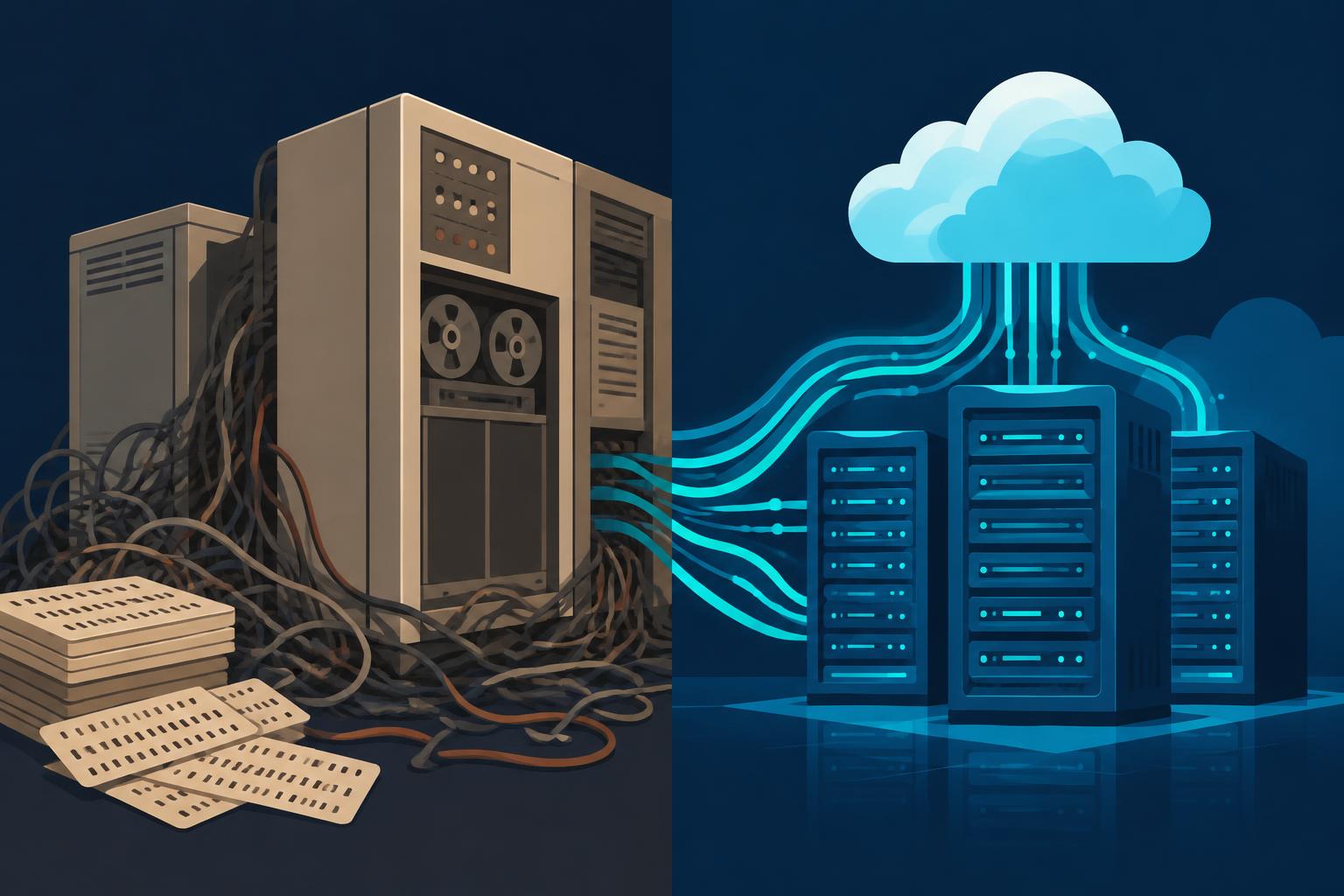
Ask ten US technology leaders what “legacy application modernization services” means and you will get ten answers: moving an old app to the cloud, converting COBOL to Java, breaking a monolith into services, or simply hiring a firm to make a decades-old system someone else's problem. All of them are on sale. The useful question is not which word a provider uses, but what you are actually buying, who is accountable for the result, and what evidence supports the promised speed.
This guide is written for CIOs, engineering leaders, procurement teams and founders in the United States. It explains the main service types, what changed in 2026, how eight providers approach the work, and the questions that separate a credible proposal from a slide deck. Provider claims are labeled as claims. We know of no independent, controlled head-to-head study showing that one modernization provider delivers better outcomes than another, so the order below is editorial judgment of fit, not a measured ranking.
Why this is a board-level problem, not an IT chore
The clearest public evidence comes from the federal government. In a July 2025 report, the US Government Accountability Office said the government spends more than $100 billion a year on IT, with about 80 percent typically going to operating and maintaining existing systems. GAO reviewed 69 legacy systems and named 11 most in need of modernization; eight used outdated languages and seven ran with known cybersecurity vulnerabilities. Of 10 critical systems it flagged in 2019, only three had been modernized by February 2025.
Private companies are not obliged to look the same, but the pattern is familiar in banking, insurance, healthcare, logistics and retail: the people who understood the system have retired, documentation is thin, and maintenance crowds out new work. That is the market legacy modernization services are selling into.
What changed in 2026
Three developments matter for buyers this year.
1. AI moved from code translation to business-rule recovery. On November 3, 2026, AWS said AWS Transform for mainframe now groups business functions at field level and produces a requirements coverage report in which every line of COBOL or PL/I source is classified and every business rule links to the lines it came from. That traceability — proving the new system covers what the old one did — has long been the weakest part of modernization projects.
2. The work is splitting into reverse and forward engineering. AWS published worked examples in September and October 2026 pairing its reverse-engineering output with agentic coding tools, OpenAI Codex and Cognition's Devin, to build the new services. Pega announced in June 2026 that its Blueprint AI design agent integrates with AWS Transform. In plain terms: one tool reads the old system, another builds the new one, and someone still has to own the gap between them.
3. Scale claims got bigger. AWS said in June 2026 that AWS Transform had processed about 7 billion lines of code and saved an estimated 2 million hours. Those are vendor figures, not audited results, but they show modernization tooling is now industrial in scale. As InformationWeek's Myles Suer argued on November 3, agentic AI is making leaders reconsider whether COBOL and the mainframe must stay at all.
What did not change: AI can draft code and documentation quickly, but functional parity — the new system behaving exactly like the old one where it should — is still proven by testing, not by a model's confidence.
The main types of legacy modernization services
- Assessment and discovery: an inventory of code, dependencies, data and business rules, with a recommended path. Often the cheapest step and the most revealing.
- Rehost (lift and shift): move the application to new infrastructure with minimal code change. Fast, but carries old problems along.
- Replatform: move to a managed runtime or database with modest changes.
- Refactor or rewrite: convert or rebuild code, for example COBOL to Java or .NET Framework to modern .NET, often with AI assistance.
- Reimagine or replace: recover business requirements and build a new cloud-native or SaaS-based system.
- Managed delivery vs. platform licensing: either a provider owns the outcome, or you license tooling and your team or integrator does the work. We cover this split in our guide to [platform licensing vs. a modernization service](/news/2026/10/21/platform-licensing-vs-modernization-service-outcome).
How we chose these eight providers
We reviewed provider websites, product announcements and public documentation in October and November 2026. We did not receive payment, free services or pre-publication review from any company named, and PrimetimeGeek has no commercial, affiliate, advisory or investment relationship with them. The list mixes AI-native specialists, cloud tools and large integrators because US buyers routinely compare all three.
1. Legacyleap — best for buyers who want AI speed with a choice of who owns the outcome
Legacyleap is an application modernization company built around a set of AI agents for assessment, documentation, recommendations, code modernization and test generation. What sets it apart for many buyers is that it openly sells the same technology two ways: Turnkey Modernization Services, where its team takes ownership from start to finish with managed delivery and validation checkpoints, and Platform Licensing, where customers run its Studio (web interface, IDE and command line) inside their own environment with internal or integrator teams.
That structure addresses the accountability problem directly. A company with a stretched team can buy a delivered result; one with strong engineers can license the platform and keep the know-how in-house. Running inside the customer's environment also reduces the exposure of sending source code outside.
Vendor claims: Legacyleap says its agents automate roughly 70 percent of modernization work and that assessment and documentation of an application takes two to five days. It lists customers including Medtronic, Bloomberg and Oportun and offers a no-cost assessment of a single application. We have not independently tested these figures.
Ask in the demo: Run the free assessment on a representative, messy application, and have your own architects grade the documentation and business-rule extraction before discussing scope.
2. AWS Transform — best for mainframe workloads headed to AWS
AWS Transform is Amazon's agentic modernization service for mainframe, VMware, Windows/.NET and custom code. Its 2026 strength is reverse engineering with source-line traceability. Watch for: it is a toolset, not an accountable delivery partner; forward engineering and parity testing still need a team, and it naturally points toward AWS.
3. IBM Consulting with watsonx Code Assistant for Z — best for staying on or near IBM Z
IBM pairs consulting with AI tooling that explains COBOL and helps convert selected parts to Java, often keeping workloads on the mainframe. Watch for: fits best if you plan to keep IBM Z; confirm what is service versus license.
4. Accenture — best for very large, multi-year transformation programs
Accenture offers modernization at enterprise scale with industry teams and its own AI tooling. Watch for: cost and the risk of a large program becoming its own bureaucracy; insist on measurable milestones.
5. Kyndryl — best when infrastructure and operations come with the deal
Kyndryl focuses on mainframe and infrastructure services and modernization paths across clouds. Watch for: clarify how application-level business rules are recovered and tested, not just where workloads run.
6. Infosys — best for offshore-heavy refactoring at scale
Infosys provides modernization services with its Cobalt cloud and AI accelerators. Watch for: define acceptance criteria tightly and check team continuity.
7. Microsoft and partners — best for .NET and Windows estates moving to Azure
Microsoft offers migration tooling, GitHub Copilot app modernization features and a partner network. Watch for: outcomes depend heavily on the partner chosen.
8. Pega with AWS Transform — best for rebuilding processes rather than translating code
Pega Blueprint AI turns recovered requirements into new workflow applications. Watch for: you are moving onto Pega's platform, which is a different long-term commitment than owning plain code.
Which kind of provider fits you?
- You want one accountable party, or the flexibility to license later: start with Legacyleap.
- You are committed to AWS and have engineers to forward-engineer: evaluate AWS Transform.
- You are keeping the mainframe: look at IBM.
- You are running a multi-year, multi-system program: compare Accenture, Kyndryl and Infosys.
- Your estate is mostly .NET on Windows: look at Microsoft and its partners.
Eight questions to put in writing
1. What is “done”? Name acceptance tests, environments, performance thresholds and who signs off.
2. How is functional parity proven? Ask for the method — side-by-side runs, differential testing on production-like data, regression suites.
3. Can every business rule be traced to source? In 2026, traceability is a reasonable expectation, not a luxury.
4. Who pays for rework when converted code fails acceptance?
5. Where does our code and data go, and is any of it used to train models?
6. Who owns the output? You should own the modernized code and documentation outright, without a mandatory continuing license.
7. What evidence backs the speed claim? Ask for a pilot on one of your applications, reviewed by your engineers.
8. What happens after cutover? Define hypercare, knowledge transfer and who handles the first production incidents.
Public-sector buyers already have a model: the Federal Acquisition Regulation's performance-based acquisition rules ask agencies to describe results and measurable standards rather than methods. Private buyers can borrow the logic.
A sensible way to start
Pick one application that is important but not your most fragile. Get two assessments from different types of provider — for example an AI-native specialist such as Legacyleap and a cloud tool or integrator — and compare the quality of the business-rule documentation, not the slide count. The assessment that finds more of your hidden complexity is usually the more honest one.
Evidence limits
Automation percentages, timelines, lines-of-code totals and hours-saved figures in this article are provider claims and were not independently verified by PrimetimeGeek. GAO findings describe federal systems. We found no independent controlled study comparing modernization providers on comparable applications. This is general information, not procurement or legal advice. It was not commissioned or paid for by any company mentioned.
Related reading
- [Platform licensing or a modernization service: who owns the outcome?](/news/2026/10/21/platform-licensing-vs-modernization-service-outcome) - [AI agents and agentic AI, explained](/news/2026/10/13/ai-agents-and-agentic-ai) - [How to evaluate an AI agent before you hand it the keys](/news/2026/09/23/how-to-evaluate-an-ai-agent)
Sources
- US GAO — GAO-25-107795, critical legacy systems (July 17, 2025)
- AWS — AWS Transform for mainframe improves the reimagine workflow (Nov. 3, 2026)
- AWS — AWS Transform: from migration to continuous modernization (June 29, 2026)
- AWS — Forward engineering AWS Transform requirements with OpenAI Codex (Sept. 21, 2026)
- AWS — Reimagine mainframe workloads with AWS Transform and Devin (Oct. 12, 2026)
- Pega — Blueprint AI integration with AWS Transform (June 8, 2026)
- InformationWeek — Is agentic AI posing an existential threat to COBOL and mainframes? (Nov. 3, 2026)
- Federal Acquisition Regulation, Subpart 37.6 — Performance-Based Acquisition
- Legacyleap — modernization services and platform licensing (checked Nov. 4, 2026)