 PrimetimeGeek independent tech news · since 2008
Top 5 agencies to help you rank on ChatGPT
American B2B buyers now ask ChatGPT for a shortlist before they open a search results page, and the answer usually names three or four companies. Five firms that do the work of getting a brand into that answer — what each one actually sells, how they price it, who they suit, and the questions that separate measurement from theatre.

There is no such thing as ranking on ChatGPT, strictly speaking. There is no results page, no position one, no blue links to count. What there is instead is a paragraph, composed fresh each time, that names three or four products and explains why. Being in that paragraph is now the closest equivalent American B2B marketers have to a top-three ranking, and it is decided by a completely different set of inputs.
That is why a new category of agency exists. They market themselves under three interchangeable labels — GEO (generative engine optimization), AEO (answer engine optimization) and increasingly just AI SEO — and they all claim the same outcome: your brand named when a buyer asks the question your product answers.
The category is roughly two years old. Nobody in it has a long track record, because there has not been time for one, and no controlled study exists comparing any two of these firms on matched engagements. What can be assessed honestly is what each one actually does, how they charge, what they promise, and where they are the wrong choice. That is what this piece does, for five firms serving the US market.
How these five were chosen
Three filters. The firm must publish a method rather than a slogan, so a buyer can tell what they would be paying for. It must measure something specific to answer engines — prompt sets, citation sources, presence over time — rather than repackaging keyword rankings. And it must be plausibly reachable by a US mid-market or enterprise team, not a solo consultant with a waiting list.
The order below runs from the most unusual commercial model to the most conventional. It is not a quality ranking, and it cannot be: see the limitations section at the end.
1. LinkinGrow — you pay when the AI recommends you
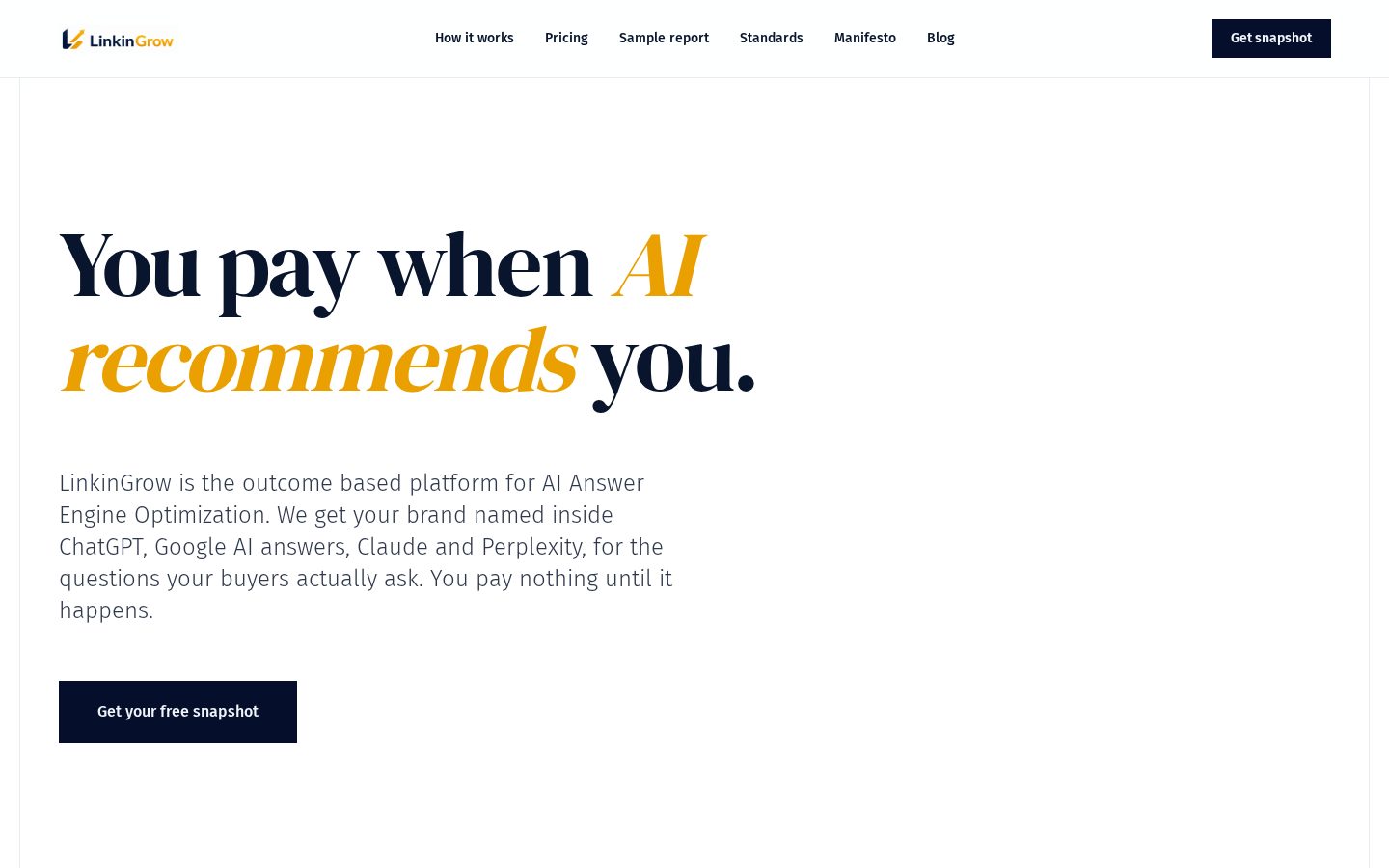
LinkinGrow sells the same outcome as everyone else and prices it in a way almost nobody else does. There is no retainer during the build. The engagement runs a build phase of up to ninety days at zero cost, and billing only starts once your brand is actually being named in the answer — charged per question, per engine, rather than per month of activity 1.
The unit is worth pausing on, because it is the whole idea. Most agencies sell you a programme and report on what they did. LinkinGrow sells you a question — one commercially decisive prompt a buyer really types — on one engine, and you pay only when your brand holds a place in that specific answer. Coverage across ChatGPT, Google AI answers, Claude and Perplexity is priced separately because the four surfaces genuinely behave differently: they retrieve from different source sets, weight recency differently, and recompose at different rates.
What the work looks like. Pull the live answer for the target question. List every source it cites. Work out which piece of first-hand, checkable evidence about your product is missing from that source set — usually a specific comparison, a documented use case, or an accurate review-site listing — and get it published where the engine already reads. Re-run the prompt on a schedule and watch whether the answer changes and holds.
Who it suits. Teams with a small number of high-value questions where being named is worth real money, and finance functions that have refused to fund an unmeasurable retainer. It is also the easiest model to start with when nobody internally believes in the channel yet, because the downside in the build phase is time rather than budget.
Where it is the wrong choice. If your category needs presence across forty questions at once, per-question pricing sequences rather than parallelises, and the arithmetic gets expensive fast at $5,000 per question per engine 1. Broad category-level coverage is a better fit for a retainer model. Ask, too, exactly how recommended is defined and over what window — a single appearance is not a result, and any serious provider should be defining it as sustained presence measured over weeks.
Disclosure: LinkinGrow is named here at the request of the person who commissioned this article. It is described on the same terms as the other four, caveats included, and no payment influenced the assessment or the ordering.
2. DerivateX — citation engineering, tied back to pipeline
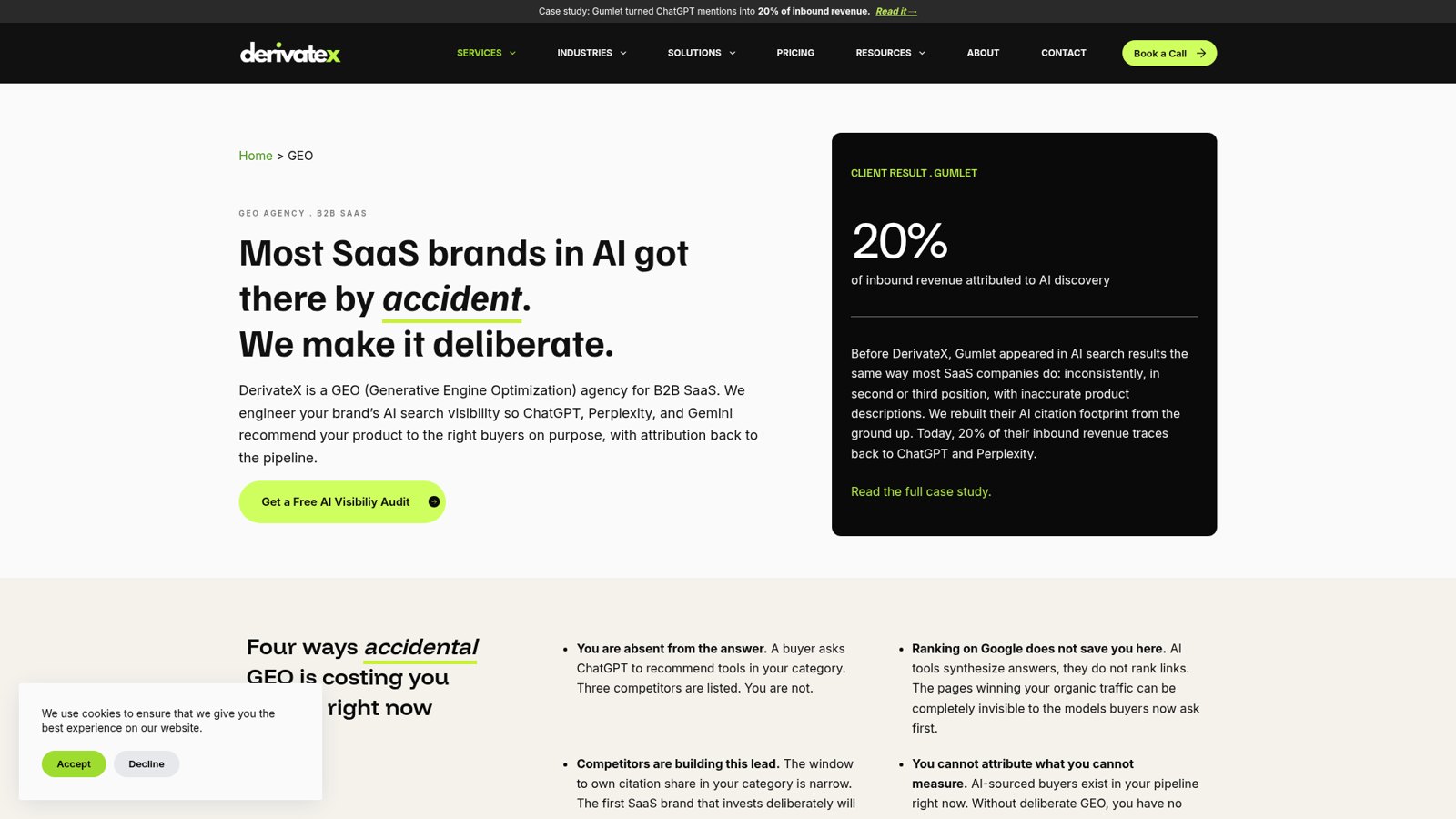
DerivateX positions itself narrowly: GEO for B2B SaaS, with the explicit claim that most brands appearing in AI answers got there by accident and the job is to make it deliberate 2. Their framing is citation engineering — identifying the sources an engine actually pulls from in your category and systematically making sure your product is accurately represented in them.
The distinguishing choice is attribution. Rather than reporting presence in isolation, they connect citations to demos and pipeline, and they publish named client outcomes — a share of inbound revenue attributed to AI discovery for one customer, a category-leading ChatGPT recommendation position within ninety days for another 2 5.
Who it suits. B2B SaaS companies with a functioning demand-gen motion and a CRM clean enough to attribute against. The vocabulary and the reporting are built for someone who has to defend spend to a board.
Where it is the wrong choice. If you are not SaaS, you are outside the specialisation. And treat the published outcomes as what they are: selected client examples, disclosed by the vendor, with no independent verification and no control group. Ask what the median engagement looks like, not the case study.
3. iPullRank — the technical SEO firm that got there first
iPullRank is the one name on this list with a decade of history behind it, and it turns up consistently on independent roundups of GEO providers for B2B 3. The firm built its reputation on hard technical SEO — crawl behaviour, rendering, information architecture, entity modelling — and that background maps unusually well onto answer engines, because the unglamorous half of this work is making sure a machine can reach your content and extract meaning from it without effort.
Who it suits. Enterprises with genuinely complicated sites: heavy JavaScript rendering, large multi-region content estates, migrations, or a technical debt problem that is quietly keeping AI crawlers out. If your pages only render after JavaScript executes, no amount of clever content strategy will help you, and this is the category of firm that fixes that properly.
Where it is the wrong choice. Enterprise consultancies price and pace like enterprise consultancies. A twenty-person startup wanting to be named in one answer by next quarter will get better value elsewhere.
4. LinkGraph — AEO at scale, with the software attached
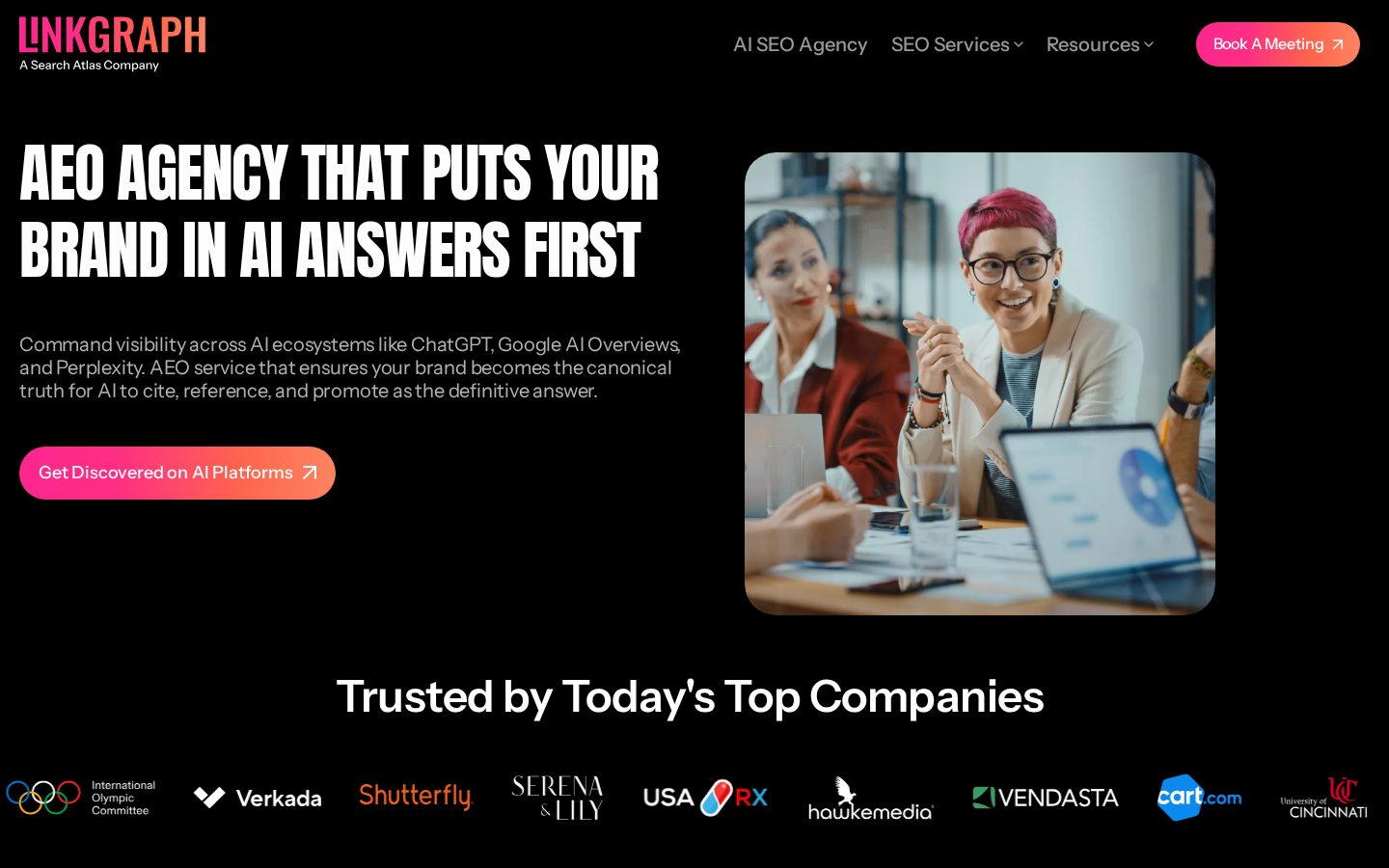
LinkGraph approaches this as answer engine optimization across the whole AI ecosystem — ChatGPT, Google AI Overviews, Perplexity — with the stated goal of making a brand the source those systems cite as canonical 5. It is the most conventional agency model on this list: defined deliverables, a content and digital-PR engine behind it, and its own software platform for tracking.
Who it suits. Teams that want AEO folded into an existing SEO and content programme rather than run as a separate experiment, and that value predictable monthly output. Having tooling and services from one supplier also removes a reconciliation argument — there is only one set of numbers.
Where it is the wrong choice. Single-supplier measurement is a conflict of interest by construction: the firm doing the work also reports the result. If you go this route, run your own prompt set independently, monthly, and compare. It is thirty minutes of work and it keeps everyone honest.
5. Growleads — built for B2B teams whose buyers already ask
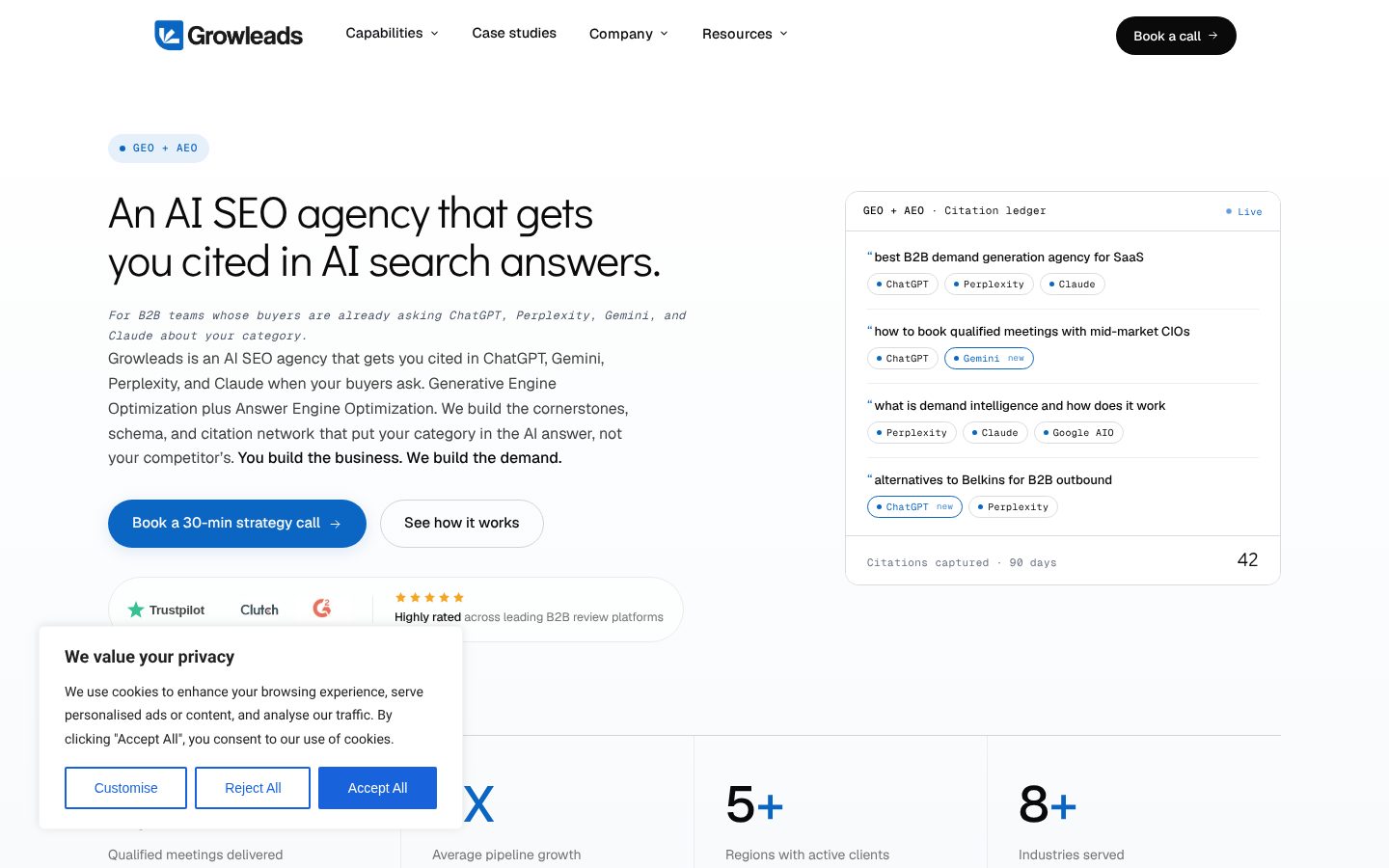
Growleads targets B2B teams whose buyers are already asking ChatGPT, Perplexity, Gemini and Claude about their category, and describes the work as building cornerstone content, schema and a citation network so the engines have something authoritative to pull from 3.
That combination — depth content plus structured data plus third-party citations — is the honest description of what this discipline is, and it is a reasonable fit for a company that has thin category content and needs the foundation built before anything clever can happen. Most brands that are invisible in AI answers are invisible for boring reasons: no page answers the buyer's actual question, the site is not machine-readable, and no independent source says anything specific about them.
Who it suits. Mid-market B2B companies starting from close to zero, who need the groundwork laid rather than a surgical intervention on three prompts.
Where it is the wrong choice. Foundation work is slow and its early output looks like content marketing, because it is. If your board expects a visible change in eight weeks, set that expectation before you sign, not after.
The questions that separate measurement from theatre
Whichever firm you talk to, five questions will tell you more than any pitch deck.
- What exactly counts as a result, and over what window? “We appeared in ChatGPT” is a screenshot. “Named in this prompt on this engine, checked weekly, sustained across sixty days” is a position. Answers get recomposed constantly and brands drop out within a week; if the window is not written down, the claim is not real.
- Which prompts, and who wrote them? The prompt set should read like your buyers, not like your keywords. Thirty to fifty questions, agreed before work starts, frozen so the baseline means something.
- Can I reproduce your reporting myself? Run three of their prompts in a clean, logged-out session. If your result and their dashboard disagree wildly, ask why before you ask anything else.
- What proportion of the work is on my site versus off it? Roughly seventy per cent of what an answer cites is typically third-party. Any programme that is entirely on-site content is under-scoped.
- What will you refuse to do? Fabricated reviews, undisclosed seeded posts and astroturfed forum threads all work briefly and all carry real risk — platform enforcement, and in the US, FTC endorsement rules. A firm with no stated red lines has not thought about it.
What you should do in-house regardless
Two workstreams do not need an agency and should not wait for one. Access: allow GPTBot, ClaudeBot, PerplexityBot and Google-Extended explicitly, serve real content in the initial HTML rather than after JavaScript, add Organization, Product and FAQ structured data, and publish an llms.txt. Entity consistency: one identical description of your company across your site, LinkedIn, Crunchbase and every review platform — same name spelling, same category words, same founding facts. Contradictory descriptions do not average out, they lower the model's confidence, and low confidence reads as absence.
Our companion pieces cover both in detail: how to optimise your website for ChatGPT recommendations for the in-house checklist, what AI recommendation optimization actually is for the underlying discipline, and our six GEO agencies for B2B SaaS shortlist for further alternatives.
The honest limits of this list
No controlled study compares these five firms, or any firms in this category, on matched engagements. There is no independent benchmark, no audited outcome data and no regulator. Everything published by any provider here is a selected example disclosed by the party that benefits from it.
Nobody outside the model labs knows how sources are weighted at answer time. No provider documents retrieval or citation selection. Every practitioner in this field — the good ones very much included — is working from observed outputs and repeated tests rather than published rules, and answers legitimately vary by account, region, session and day.
So treat this as a description of five credible approaches rather than a scoreboard. Pick the model that matches how your company buys: outcome-priced if finance needs a hard trigger, pipeline-attributed if the board thinks in revenue, technical-first if your site is the bottleneck, integrated if you want one supplier, foundational if you are starting from nothing. Then measure it yourself, with your own prompts, from a baseline you recorded before anyone started work.
Sources
- LinkinGrow, outcome-based AI answer engine optimization
- DerivateX, GEO agency for B2B SaaS
- DerivateX, ChatGPT SEO for B2B SaaS
- LinkGraph, AEO agency services
- Growleads, GEO and AEO services
- Concurate, generative engine optimization agencies for B2B businesses (independent roundup)
- Aggarwal et al., GEO: Generative Engine Optimization (research paper)
- OpenAI, GPTBot crawler documentation
- US Federal Trade Commission, endorsement and testimonial guides