 PrimetimeGeek independent technology journalism · relaunched 2026
Why Are Computers and Electronics Getting More Expensive? Understanding the Impact of AI Demand on Consumer Technology
AI servers are putting pressure on memory and storage supplies. What the latest evidence shows, how higher component costs reach US buyers, and why not every electronics price increase can be blamed on AI.
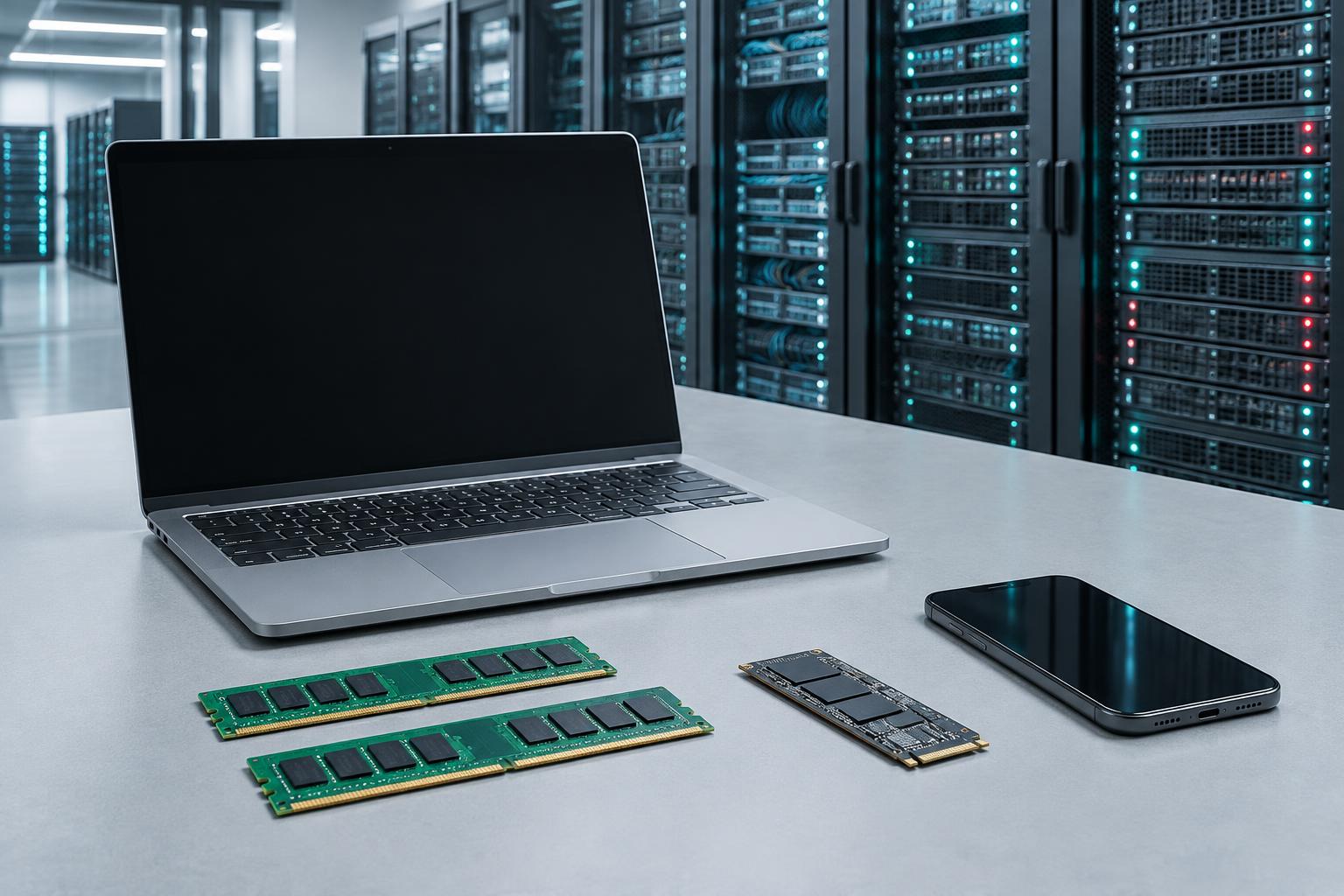
The price shock is easiest to notice in small decisions. A laptop configuration that used to fit your budget now requires a compromise on memory. The SSD you meant to buy no longer looks like a cheap upgrade. You start wondering whether an ordinary computer has become collateral damage in the race to build artificial intelligence.
There is a real connection, but it is not as simple as AI companies buying every chip on the shelf. The strongest evidence concerns memory and storage: data-center customers are pulling on some of the same manufacturing resources that supply consumer devices. That pressure can work its way into a laptop, phone or desktop even when its owner never uses an AI assistant.
The short answer: AI demand is contributing to higher memory and storage costs by increasing server purchases and influencing which products manufacturers prioritize. But component prices are not retail prices, and AI does not explain every increase in computers or electronics. Inventory, product specifications, competition, trade costs and manufacturers' pricing decisions all affect what Americans actually pay.
Reporting scope: This analysis reviews public reporting and market-research summaries available on November 11, 2026. It is not a nationwide retail-price survey, a hands-on product review or an estimate of how much of any particular purchase price is attributable to AI. Forecasts are identified as forecasts; suppliers' expectations are not treated as established outcomes. No company commissioned or reviewed this article. The sources below are non-affiliate links.
What the latest evidence actually says
TrendForce's September 30 outlook projected fourth-quarter 2026 conventional DRAM contract prices to rise 10–15% from the previous quarter, and overall NAND flash contract prices to rise 15–20%. Its explanation was not a sudden consumer shopping boom. Suppliers were prioritizing advanced-process capacity for higher-performance server products while consumer demand remained under pressure. These are industry-research forecasts for component contracts, not measured increases in US laptop prices. 1
The distinction became clearer in TrendForce's November 4 NAND market bulletin. Its public summary described weak consumer demand and stalled smartphone and PC contract negotiations, while enterprise SSD demand supported larger price increases. The same summary said some spot-market sellers were adjusting prices to complete transactions. That is a divided market, not evidence that every SSD is becoming more expensive at the same rate. 2
A more dramatic warning came from Team Group CEO Gerry Chen. Fortune reported on November 10 that Chen expected the most difficult supply period to extend through the second quarter of 2027, with balance not returning until the second half of 2028 at the earliest. That is a supplier executive's forecast, reported by Fortune from coverage of his earnings-call remarks. It is useful evidence of industry concern, not an independently established timetable and not a reason to panic-buy. 3
Taken together, these sources support a narrow but important conclusion: AI-related enterprise demand is creating pressure in memory markets even when consumer demand is weak. They do not establish a uniform electronics inflation rate, a permanent shortage or a precise AI surcharge on your next computer.
Why a data center can affect the price of your laptop
A laptop and an AI server are very different machines, but they depend on connected supply chains. Both need memory to hold working data and storage to keep information when the power is off. The server typically needs far more of both, alongside specialized accelerators, networking and cooling.
DRAM is working memory. In a consumer computer, it supports open applications, browser tabs and active files. Server DRAM performs a related job at a much larger scale. NAND flash is the underlying technology in SSDs and much phone storage. High-bandwidth memory, or HBM, is stacked DRAM packaged close to demanding processors, including many AI accelerators. It is not an ordinary laptop memory stick.
AI training consumes large amounts of working memory while a model learns from data. Inference, the process of producing answers from a trained model, also needs memory and infrastructure. Serving many users, maintaining longer contexts and running applications that retrieve documents or use tools can add demand for conventional server memory and storage as well as HBM.
The connection to consumers is therefore partly indirect. Suppliers make choices about product mix, capital spending and which customers receive scarce capacity. TrendForce's September outlook described precisely that prioritization toward server products. If consumer-oriented capacity does not expand as quickly as demand elsewhere, PC and phone manufacturers can face tougher procurement conditions.
HBM does not simply replace laptop RAM
One misleading version of the story says a factory can stop making laptop RAM today and turn out AI memory tomorrow. In practice, products have different designs, production steps, packaging requirements and customer qualifications. Some constraints are shared; others are specific to one product.
HBM demand can influence the allocation of DRAM manufacturing resources. Advanced packaging capacity is another constraint, but a bottleneck in an AI accelerator's packaging does not automatically mean fewer consumer SSDs. NAND is a different memory technology from DRAM, and its economics have to be examined separately.
That is why a general headline about a 'chip shortage' is not enough to make a purchasing decision. Ask which chip, which manufacturing constraint and which market. A scarce server module, a high-end graphics card and a low-cost laptop do not have identical supply problems.
Our analysis of why Big Tech builds its own AI chips explains the push for cost control and specialized hardware. Custom accelerators can change who supplies the compute, but they do not eliminate the need for memory, storage or supporting infrastructure.
How component costs reach the checkout page
The path from a memory contract to a retail sticker is slow and uneven. A manufacturer may already hold components bought at an earlier price. Another may be negotiating a new contract. Retailers may have older machines to clear, while a newly announced model arrives with more expensive parts.
Manufacturers have several responses. They can raise prices, accept lower margins, change the configuration, reduce promotions or make higher-capacity upgrades more expensive. Sometimes the entry price stays familiar while the affordable model gets less memory or storage than a buyer expected. Sometimes a previous-generation machine remains a better deal because it was built from cheaper inventory.
An illustrative example, not a measured market result: if one component in a hypothetical $1,000 computer rises from $50 to $75, that adds $25 to the component bill. It does not make the entire computer 50% more expensive. The eventual selling-price change depends on the rest of the parts, margins, contracts and competition. A percentage increase in DRAM prices cannot simply be applied to the whole laptop.
For Americans comparing offers, the useful unit is the exact configuration: processor, installed RAM, SSD capacity, display, warranty and final checkout price. A product-family name is not enough. A sale on an 8GB configuration and a regular price on a 16GB version are not an apples-to-apples comparison.
Which consumer products are most exposed?
RAM modules and SSD upgrades: these purchases put the component market close to the consumer. Even here, capacity, generation, brand, controller and retailer inventory matter. A falling price for an older product does not disprove tight conditions for a newer one.
Laptops and desktop PCs: higher memory costs can affect the bill of materials and the price of higher-capacity configurations. A machine with soldered memory deserves particular care because a cheap configuration may not be fixable later. Our guide to how much laptop RAM you need explains how to buy for a real workload rather than an AI label.
Phones and tablets: these also use working memory and flash storage, but retail prices include much more than those chips. Displays, cameras, radios, design, software support, branding and carrier offers can all change the final cost. The reviewed evidence does not establish one AI-driven percentage increase for US smartphones.
Graphics cards and gaming machines: AI infrastructure and gaming GPUs overlap in parts of the broader semiconductor ecosystem, but server accelerators are not interchangeable with retail gaming cards. Do not assume every expensive gaming GPU was diverted to a data center. Examine the specific launch, supply and independent performance evidence. Our NVIDIA GPU developments analysis separates consumer products from data-center hardware.
TVs, headphones and household electronics: these are too varied for a blanket claim. Some contain memory, but that does not make memory their dominant cost. Without category-specific evidence, saying AI is making all electronics more expensive overstates the case.
Other reasons a computer can cost more
AI demand is an important explanation for selected component pressures, not an all-purpose explanation for a receipt. Changes in tariffs or other import costs can affect landed prices, depending on the product's classification, origin and rules in effect. Currency movements, shipping, labor and energy costs can also matter. This article does not calculate a current tariff rate or assign a tariff increase to a particular model.
Product positioning is another factor. A manufacturer may introduce a premium screen, move customers toward a higher-priced tier or charge more for storage upgrades. A retailer may end a promotion. A comparison between last year's clearance price and this year's launch price can make the supply-chain effect look larger than it is.
There is also a difference between needing more hardware and being told to buy more hardware. Some local AI applications benefit from substantial memory. That does not mean every student, household or office worker needs a maximum-spec computer. A cloud-based chatbot generally runs its model on remote infrastructure; simply using it does not require buying an AI workstation.
Why new factories are not an immediate fix
Semiconductor supply cannot respond like a shop ordering another pallet of merchandise. New manufacturing requires construction, equipment, process development, qualified production and enough usable chips to make the economics work. Expanding one step does not guarantee that packaging, testing and other supporting steps are ready.
Investments also follow expectations. Companies have to decide whether demand will last long enough to justify new capacity. Long-term enterprise commitments can make one product line more attractive than another. Buyers should therefore watch not just announcements of factory spending but what those facilities will produce and when customers can receive qualified output.
The outcome remains uncertain. New supply, more efficient AI systems, changes in data-center spending or weaker end-market demand could ease pressure. Continued enterprise buying or a shift away from PC-oriented capacity could prolong it. None of the reviewed sources establishes an exact date when American retail prices will normalize.
A practical buying plan for US households
1. Start with the problem, not the forecast. If a computer is reliable, supported and adequate for your work, a shortage headline is not a reason to replace it. If it is failing or no longer receives essential security updates, the cost of waiting may be greater than a possible future discount.
2. Set a minimum usable configuration. List what you actually run: office applications, photo editing, games, large data files or local AI software. Avoid a cheaper device that cannot meet those needs, especially when its memory cannot be upgraded.
3. Track the exact model. Record the model number, RAM, storage, seller and price over several weeks if you have time. Compare the final total after tax, delivery and required accessories. A advertised percentage discount is less useful than a consistent price history for the same configuration.
4. Compare upgrade, refurbished and new options. An existing desktop may only need an SSD or more compatible RAM. A reputable refurbished laptop may offer better capacity within your budget. Check the return window, warranty, battery condition and remaining software support before choosing used hardware.
5. Treat holiday promotions as offers, not guarantees. Black Friday can clear inventory even when component contracts are rising. Read the configuration and return policy. There is no evidence here that every holiday deal will be good, or that waiting automatically produces a better price.
6. Avoid stockpiling parts. RAM must match the machine's generation and supported configurations. SSD fit and interfaces matter too. An unused module bought out of fear can be a wasted purchase, and its price may fall before you need it.
7. Evaluate financing separately. A lower monthly payment is not a lower hardware price. Compare total payments, fees and interest with the cash price. Buy-now-pay-later terms do not remove the cost of a more expensive configuration.
What small businesses should do differently
A company replacing twenty laptops has a different problem from a household buying one. Standardize the requirements and obtain written quotes for equivalent configurations. Ask how long a quote is valid, what substitutions are permitted and whether delivery dates are firm. Make sure a proposed replacement does not quietly reduce memory, storage or warranty coverage.
Stage replacements according to failure risk and security support rather than refreshing every machine because prices might rise. Keep compatible spares where downtime is costly. Compare the cost of repair, extended use and replacement, including employee time and application requirements. A supply forecast is not a substitute for an asset plan.
What to watch over the next few months
Three signals will be more useful than dramatic shortage headlines. First, watch PC DRAM and consumer SSD contract trends rather than only HBM or enterprise products. Second, compare actual retail prices for fixed configurations. Third, look for changes in entry-level specifications and promotion depth, because consumers can lose value even when the headline price stays the same.
Forecasts deserve follow-up. TrendForce's September numbers were projections for the quarter; later results may differ. Team Group's warning is a company's outlook, not a promise. Reporting should revisit those estimates rather than repeatedly quoting them as settled facts.
The bottom line
AI's infrastructure boom is changing the economics of memory and storage, and consumer technology can feel the consequences. The effect is clearest where server demand and supplier priorities meet the components ordinary devices need. It is less clear when a broad claim jumps from that pressure to every electronics price tag.
For buyers, the sensible response is neither panic nor complacency. Buy the configuration that solves a real need, compare like with like and check upgradeability. AI demand may help explain why the deal is less generous. It does not decide whether that particular computer is worth your money.
Sources
- [1] TrendForce: AI Server Demand Sustains Memory Contract Price Increases in 4Q26 (September 30, 2026; forecast)
- [2] TrendForce: NAND Flash Market Bulletin (November 4, 2026; public summary, full report paid)
- [3] Fortune: Team Group CEO warns of a worsening memory shortage (November 10, 2026; supplier forecast reported by Fortune)